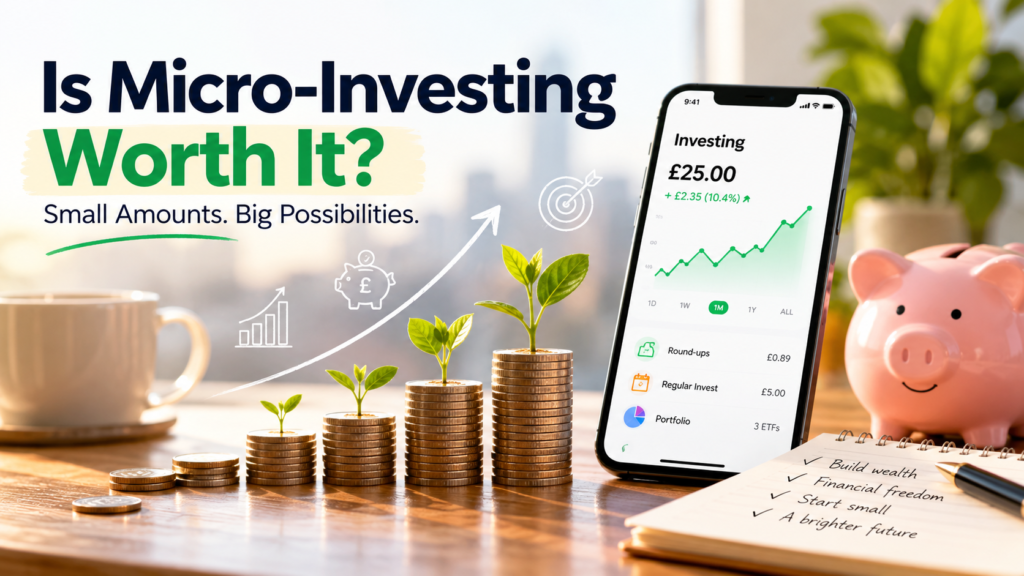

Micro-investing has made investing feel more accessible than ever. Instead of waiting until you have hundreds or thousands of pounds available, you can start with small amounts and build an investing habit over time. But is micro-investing actually worth it, or does investing tiny amounts create more hype than wealth?
The answer depends on what you expect from it. Micro-investing can be a practical way to get started, automate good financial habits and gain experience in the market. However, small contributions, investment fees and unrealistic expectations can limit the results.
This guide looks at the real pros and cons of micro-investing, who it may suit, and when another approach could make more sense.
What Is Micro-Investing?
Micro-investing means investing relatively small amounts of money, often through an app or online investment platform. Some services let you invest a few pounds at a time, schedule small recurring contributions or automatically invest spare change from everyday purchases.
The basic idea is simple: you do not need to be wealthy before you begin investing.
If you are completely new to the concept, read our beginner’s guide to micro-investing for a fuller explanation of how it works.
So, Is Micro-Investing Worth It?
Micro-investing can be worth it when it helps you start investing consistently, keeps costs reasonable and fits into a broader financial plan. It is less useful if high fees consume a meaningful share of your contributions or if you expect very small investments to produce large amounts of wealth quickly.
The biggest value of micro-investing is often not the size of your first investment. It is the behaviour you build around it.
For example, someone who starts with £10 a week may develop the habit of investing regularly. As their income increases, they may later raise that amount to £25, £50 or more. Starting small can therefore act as a bridge between “I should invest someday” and actually becoming an investor.
The Pros of Micro-Investing
1. You Can Start With a Small Amount
Traditional investing can appear intimidating when you assume you need a large lump sum. Micro-investing lowers that psychological barrier.
Even when the amount is modest, starting can help you understand how investments move in value and how you react emotionally to market changes.
Wondering what a realistic starting amount looks like? See how much money you need to start investing.
2. It Can Make Investing a Habit
Consistency is one of the strongest arguments for micro-investing. Automated weekly or monthly contributions remove some of the temptation to repeatedly decide whether now is the “right” time to invest.
Regular investing also means you buy at different market prices rather than trying to predict every rise and fall. This approach is closely related to pound-cost averaging.
3. It Can Reduce the Fear of Getting Started
Putting a large sum into the market for the first time can feel uncomfortable. Beginning with a smaller amount may make normal market volatility easier to experience and understand.
This does not remove investment risk. Your portfolio can still fall in value. But starting small can give you time to learn without committing more money than you are comfortable risking.
4. Fractional Investing Can Improve Access
Some platforms support fractional shares, allowing investors to buy part of a share rather than paying for a whole share. This can make higher-priced investments accessible to people contributing smaller amounts.
Our guide to fractional shares explains how this works in more detail.
5. Automation Can Reduce Procrastination
A recurring investment can happen in the background after you set it up. This can be useful for people who want to invest but repeatedly forget, postpone the decision or spend money that they had intended to invest.
Automation does not mean you should ignore your finances. You still need to review fees, risk, your investment choices and whether the contribution remains affordable.
6. Small Contributions Can Grow Over Long Periods
Returns generated by an investment may themselves generate future returns. Over long periods, this compounding effect can become meaningful, although investment returns are never guaranteed.
Time matters significantly. A small amount invested for many years has more opportunity to compound than the same amount invested shortly before you need the money.
Read our explanation of compound growth and small investments to understand the principle.
The Cons of Micro-Investing
1. Small Contributions Still Produce Small Starting Balances
Micro-investing can help you begin, but it cannot change the mathematics of investing. If you invest only a few pounds occasionally, your portfolio is likely to remain relatively small unless you gradually increase your contributions or give it a very long time.
This is why micro-investing works best as a starting strategy rather than an excuse to keep contributions unnecessarily low forever.
2. Fees Can Matter More When Your Balance Is Small
A fixed monthly platform fee can represent a surprisingly high percentage of a small portfolio.
Imagine paying £3 per month for an account holding £300. That is £36 per year, equivalent to 12% of the £300 balance before considering investment performance. The exact calculation changes as contributions and portfolio value change, but the example shows why costs deserve attention.
Check platform fees, fund charges, trading costs, foreign-exchange fees and any other applicable charges. Our micro-investing fees guide covers the main costs to watch.
3. Your Investments Can Lose Value
Micro-investing is still investing. Using small amounts does not turn market investments into savings accounts.
Stocks, funds and other assets can decline. You may get back less than you invested, particularly if you need to sell during a market downturn.
Before investing, understand the main investment risks beginners should know.
4. Apps Can Make Investing Feel Too Easy
A simple interface can be helpful, but it can also create the impression that investing requires little thought. The ease of tapping a button should not replace understanding what you own, why you own it and how much risk you are taking.
Features such as notifications, frequent portfolio updates and simplified performance displays can also encourage some investors to check their accounts too often or react emotionally to short-term movements.
5. Micro-Investing Is Not a Substitute for an Emergency Fund
Money you may need unexpectedly is usually different from money you can invest for the longer term. Investments can fall just when an emergency occurs, forcing you to sell at an unfavourable time.
For many people, establishing accessible cash savings is an important step before increasing investment contributions. See our guide on whether you should build an emergency fund before investing.
6. It Can Create Unrealistic Expectations
Social media sometimes presents investing as a shortcut to wealth. Micro-investing is not that.
Small, regular investments can contribute to long-term wealth building, but results depend on your contributions, investment returns, fees, taxes where applicable and the length of time you remain invested.
When Micro-Investing May Be Worth It
Micro-investing may make sense if you are a beginner who wants practical experience, you have limited disposable income, you want to automate small recurring investments, or a low minimum investment is important to you.
It can also be useful when your alternative is continually postponing investing because you believe you need a large lump sum first.
The key is to treat micro-investing as part of a financial plan rather than a standalone wealth hack.
When Micro-Investing May Not Be Worth It
It may be less attractive when the platform’s fees are high relative to your balance, you already have enough capital to use a more cost-effective investment account, you are carrying expensive debt that should take priority, or you need the money in the near future.
Your investment time horizon matters because market investments can fluctuate substantially over shorter periods. Learn more in our guide to investment time horizons.
Micro-Investing vs Traditional Investing
The distinction is often smaller than it appears. Both approaches can ultimately give you exposure to shares, funds or other investments. The major differences are usually contribution size, platform design, automation and accessibility.
A micro-investing app may be convenient for a beginner contributing £5 or £10 at a time. Someone investing hundreds of pounds every month may instead prioritise broader investment choices, tax-efficient accounts and the lowest overall costs.
See our full micro-investing vs traditional investing comparison.
How to Decide Whether Micro-Investing Is Right for You
Before opening an account, ask yourself a few practical questions:
- Do I have money available that I will not need for everyday expenses?
- Do I have an appropriate emergency fund?
- Do I understand that investment values can rise and fall?
- What are the platform and investment fees?
- What exactly will my money be invested in?
- How long can I leave the money invested?
- Can I increase my contribution later as my finances improve?
If you cannot answer these questions yet, that does not necessarily mean you should never invest. It means you may benefit from learning more before committing money.
How to Make Micro-Investing More Effective
If you decide micro-investing suits you, focus on the fundamentals rather than chasing excitement.
Keep fees low. Compare the total cost of different platforms, especially if your balance is small.
Invest consistently. A repeatable contribution that fits your budget may be easier to maintain than occasional bursts of investing.
Diversify appropriately. Avoid assuming that owning several individual investments automatically creates a well-diversified portfolio. Our guide explains how to diversify a small investment portfolio.
Think long term. Investing is generally more suitable for goals where you can tolerate market fluctuations and leave your money invested.
Increase contributions when affordable. Starting with £5 does not mean you must invest £5 forever. As your income and financial position improve, increasing contributions may have a much larger effect on your eventual portfolio than searching for unrealistic returns.
A Simple Example
Suppose two beginners both want to start investing.
Investor A waits several years because they believe they need £5,000 before investing. Investor B starts with £10 per week through a low-cost option and uses the experience to learn about risk, diversification and market volatility.
After a year, Investor B may not have built a fortune. But they have developed a habit and gained practical experience. If they later increase their contributions as their income grows, that early habit may prove valuable.
That is where micro-investing can be powerful: not because a tiny contribution magically creates wealth, but because it can make starting easier and consistency more natural.
Frequently Asked Questions
Is micro-investing good for beginners?
It can be. Low minimums and automation can make the first steps easier, but beginners should still understand fees, diversification and the possibility of losing money.
Can you make money from micro-investing?
Investments can generate positive returns, but returns are not guaranteed. The outcome depends on what you invest in, market performance, fees, contribution amounts and how long you remain invested.
Can you lose money micro-investing?
Yes. If the investments in your account fall in value, your portfolio can be worth less than the amount you invested. Micro-investing reduces the amount needed to participate; it does not eliminate market risk.
Is investing £1 or £5 worth it?
A very small contribution is unlikely to create substantial wealth by itself, but it can help establish an investing habit. The long-term impact becomes more meaningful if contributions increase over time and costs remain proportionate.
Should I save or micro-invest?
It depends on the purpose of the money. Cash savings are generally more suitable for emergencies and short-term needs, while investing involves risk and is usually considered for longer-term goals. Read our guide to saving vs investing for a detailed comparison.
Final Verdict: Is Micro-Investing Worth It?
For many beginners, micro-investing can be worth it as a starting point. It lowers the financial barrier to investing, can automate consistent contributions and provides an opportunity to learn how markets behave with relatively small sums.
But it has limits. Small investments remain small unless you keep contributing, fees can disproportionately affect small balances, and every market investment carries risk.
The strongest approach is to use micro-investing intentionally: start with an affordable amount, understand what you own, keep costs under control, diversify appropriately and increase your contributions when your finances allow.
This article is for general educational information only and does not constitute personal financial advice. Investments can fall as well as rise in value, and you may get back less than you invest.