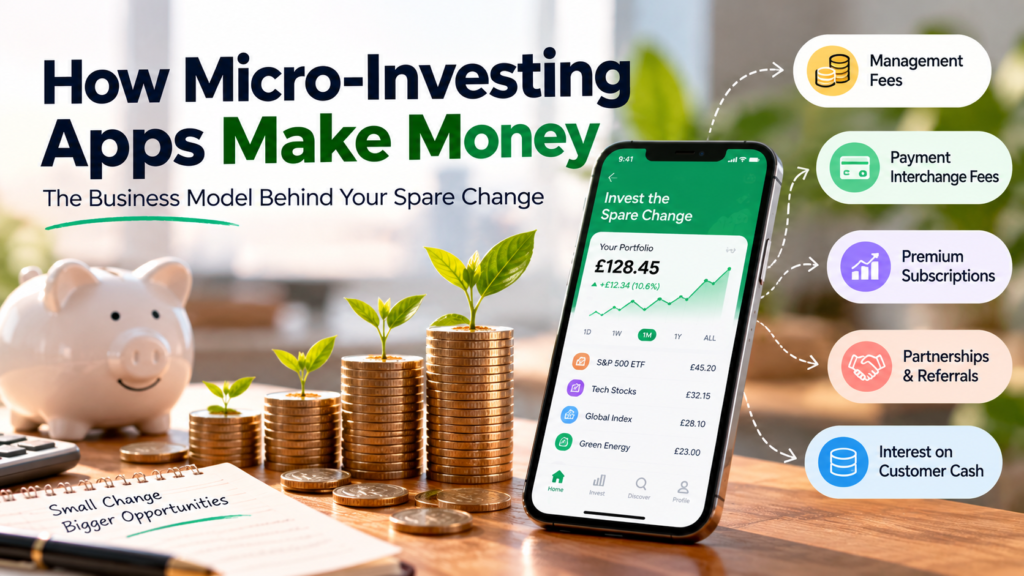

Micro-investing apps can make investing feel almost effortless. You download an app, deposit a small amount, perhaps switch on automatic contributions or round-ups, and begin building a portfolio. But if an app is cheap—or even appears to be free—an important question remains: how do micro-investing apps actually make money?
The answer matters because a platform’s business model can affect the fees you pay, the products you see, how your cash is handled and, in some cases, the incentives behind the service.
This guide explains the most common ways micro-investing platforms earn revenue and shows what beginners should check before choosing one.
Why Understanding an Investing App’s Business Model Matters
An investing platform is a business. It needs revenue to operate its technology, customer support, regulatory infrastructure, marketing and investment services. There is nothing inherently wrong with a platform making money. The important issue is whether you understand how it makes money and what that means for you.
If you are new to the concept itself, start with our guide to what micro-investing is. If you are comparing platforms, our micro-investing apps checklist for beginners covers the broader features worth reviewing.
1. Monthly or Annual Subscription Fees
One of the simplest revenue models is a fixed subscription. You may pay a set amount every month or year for access to the platform, certain portfolios or premium features.
A fixed fee is easy to understand, but it can be disproportionately expensive when your portfolio is small. For example, £36 a year represents 12% of a £300 balance before considering investment performance. As the portfolio grows, the same £36 becomes a smaller percentage of your assets.
This is why beginners should compare charges in percentage terms as well as pounds. Our detailed guide to micro-investing fees explains the costs that can reduce returns.
2. Percentage-Based Platform Fees
Some platforms charge a percentage of the value of your investments rather than a flat subscription. If a platform charged 0.50% annually, for example, the pound cost would rise as your portfolio grows.
This structure can be attractive for very small balances because the initial charge may be modest. However, a percentage fee can become more expensive in cash terms as your account becomes larger.
When comparing platforms, calculate what the fee could cost at your current balance and at the balance you hope to reach later.
3. Fund Management Charges
Many micro-investing services place users into funds or exchange-traded funds rather than individual shares. Those underlying investments may have their own ongoing charges.
These costs are not always collected as a separate monthly payment. They are often reflected within the fund itself, which can make them less visible to beginners.
Always distinguish between the platform fee and the cost of the underlying investments. A low platform fee does not necessarily mean your total investing cost is equally low.
4. Trading Fees and Commissions
A platform may charge when you buy or sell investments. Traditional dealing commissions have become less prominent on some consumer investing apps, but they still exist in parts of the market and may apply to particular products or account types.
Frequent trading can make transaction costs more important. Micro-investing is often designed around regular long-term contributions rather than constant buying and selling, so understand whether your behaviour could trigger additional charges.
5. Foreign-Exchange Fees
If you use pounds to buy an investment priced in another currency, the platform may convert your money and charge a foreign-exchange, or FX, fee.
This can matter for investors buying US shares or other overseas assets. An app might advertise commission-free trading while still earning revenue from currency conversion.
“Commission-free” therefore does not always mean “cost-free.” Look at the complete pricing schedule.
6. The Bid-Ask Spread
Investments can have a difference between the price at which they can be bought and the price at which they can be sold. This is known as the bid-ask spread.
Depending on the platform, product and execution model, spreads can contribute directly or indirectly to trading economics. Beginners do not need to become market-structure experts, but they should understand that the visible headline fee is not the only potential cost associated with a transaction.
7. Interest Earned on Uninvested Cash
Your account may temporarily hold cash that has not yet been invested. A platform may place client cash with banks or eligible institutions and earn interest on those balances, subject to its arrangements and applicable rules.
Some providers pass part of the interest to customers, some offer specific cash rates, and business models differ. Check what happens to your uninvested cash rather than assuming it receives the same rate you might find in a savings account.
8. Premium Features and Paid Tiers
A basic investing account may be inexpensive while advanced tools sit behind a paid plan. Premium tiers can include additional account types, research, faster support, portfolio features or other services.
This “freemium” model is common across technology businesses: attract users with a basic service and earn revenue when some upgrade.
Before paying for a premium tier, ask whether the features genuinely improve your investing process or simply make the app feel more sophisticated.
9. Securities Lending
Some investment providers may participate in securities lending, where eligible securities are temporarily lent to other market participants in return for a fee. The exact structure, eligibility, risks and sharing of revenue vary by provider and jurisdiction.
If securities lending applies to your account or investments, read the platform’s disclosures. Understand whether you can opt out, how collateral is handled and how any revenue is divided.
10. Revenue From Partner Products or Referrals
An investing app may also earn money by referring users to related financial products or services. Depending on the business, that could include banking, insurance, credit, financial advice or other products.
Commercial partnerships are not automatically a problem, but you should distinguish between a neutral educational suggestion and a recommendation that may generate revenue for the platform.
11. Managed Portfolio or Advice Fees
Some apps go beyond execution and provide managed portfolios, automated investment selection or regulated advice. These services may carry an additional management or advice fee.
Automation can be convenient, especially for beginners, but convenience should be weighed against total cost and the value of the service received.
Why “Free Investing” Still Needs Careful Reading
The word free is powerful marketing. A platform may genuinely charge no commission for a particular type of trade while earning money elsewhere.
Potential revenue sources can include FX charges, subscriptions, interest margins, spreads, premium tiers or other services. This does not mean a zero-commission platform is necessarily bad. It means you should judge the total cost and overall service, not one headline price.
How Fees Can Affect a Small Portfolio
Costs matter at every portfolio size, but fixed fees are particularly noticeable when you invest small amounts. Imagine two investors each paying £36 per year:
- For a £300 portfolio, £36 equals 12% of the starting balance.
- For a £3,000 portfolio, £36 equals 1.2%.
- For a £30,000 portfolio, £36 equals 0.12%.
This simple example ignores contributions and investment returns, but it demonstrates why a fee that sounds small in pounds can be significant for a micro-investor.
If you are still deciding whether the approach makes sense for you, read whether micro-investing is worth it for a broader look at the advantages and disadvantages.
Does the App’s Revenue Model Create a Conflict of Interest?
Sometimes incentives deserve attention. If a business earns more when customers trade more frequently, for example, you should be cautious about app features that encourage unnecessary activity. If it earns revenue from particular products, understand whether those products are being promoted to you.
A well-designed investing experience should help you make decisions appropriate to your goals and risk tolerance—not simply maximise engagement.
Investing also involves the possibility of loss regardless of how an app earns money. Our guide to micro-investing risks explains the main risks beginners should understand.
What to Check Before Choosing a Micro-Investing App
Before opening an account, review the provider’s official fee schedule and disclosures. In particular, look for:
- monthly or annual subscription fees;
- percentage-based platform charges;
- underlying fund costs;
- buying and selling fees;
- foreign-exchange charges;
- cash interest arrangements;
- withdrawal or transfer charges where applicable;
- premium-plan costs;
- securities-lending terms; and
- any other material sources of revenue disclosed by the provider.
Then compare those costs with the features you actually need. The cheapest platform is not automatically the best, but paying for features you never use can unnecessarily reduce your returns.
Cost Is Only One Part of Choosing an App
Fees matter, but they are not the entire decision. Consider the investments available, diversification options, account security, regulation, customer support, ease of transferring assets and whether the platform supports your long-term goals.
If your platform offers fractional investing, our guide to fractional shares and how they work explains why they can make higher-priced investments more accessible to small investors.
For investors making regular contributions, it is also useful to understand pound-cost averaging and regular investing.
Questions to Ask Yourself
Before committing to a platform, ask:
- Can I clearly explain how this app makes money?
- What will I pay each year at my expected portfolio size?
- Are there costs outside the headline platform fee?
- Does the app encourage me to trade more than necessary?
- Do I understand what my money is actually invested in?
- Can I move my investments elsewhere if my needs change?
If the pricing structure is difficult to understand, take more time before depositing money.
Frequently Asked Questions
How do free investing apps make money?
Business models vary. Potential revenue sources include subscriptions, FX fees, interest on cash, premium services, spreads, securities lending and other disclosed services. Check the individual provider’s current terms rather than assuming all apps work the same way.
Are micro-investing apps expensive?
Some can be low-cost, while others may be relatively expensive for small balances. The key is to compare total annual costs with the size of your portfolio and the service you receive.
Are subscription fees bad for micro-investors?
Not automatically. A fixed subscription may provide useful services, but it can represent a high percentage of a very small portfolio. Calculate the effective percentage cost before deciding.
Does commission-free mean there are no fees?
No. Commission-free usually refers to a specific trading commission. Other charges, such as FX fees, fund expenses or subscriptions, may still apply.
Should I choose the cheapest investing app?
Cost is important, but also consider investment choice, diversification, security, regulation, service quality and whether the platform fits your goals.
Final Thoughts
Micro-investing apps can make investing accessible, convenient and easy to automate. But the app still needs a sustainable way to earn revenue.
For investors, the goal is not to find a company that makes no money. It is to choose a platform whose costs are transparent, reasonable for your portfolio size and aligned with the service you need.
Read the fee schedule, understand the underlying investments, look beyond “free” marketing and review your costs as your portfolio grows. A few minutes spent understanding how a platform earns money can help you make a more informed long-term decision.
This article is for general educational information only and does not constitute personal financial advice. Investments can fall as well as rise in value, and you may get back less than you invest. Fees, products and provider terms can change, so check the provider’s current official information before making a decision.