
What Happens If Returns Are Reinvested?
Reinvestment is one of the clearest ways to understand compounding. Suppose an investment produces a £10 distribution and the investor takes the £10 as cash. That £10 is no longer invested. If the distribution is instead reinvested, it becomes part of the investment and can participate in future gains or losses.
Whether reinvestment happens automatically depends on the investment and provider. Some funds or platforms offer accumulation or reinvestment options, while others may pay distributions as cash. Always check the current terms and charges.
Compounding Works in Both Directions
It is easy to describe compounding only as a wealth-building effect, but investment values do not move in a straight line. A portfolio that falls by a percentage can reduce the base from which later gains are calculated.
For example, a hypothetical £100 investment that falls 20% becomes £80. A later 20% gain would increase £80 to £96, not return it to £100. This is why a percentage loss and the same percentage gain do not cancel each other out.
The FCA explains that investment returns can be negative as well as positive and that investments involve risk. Diversification and an appropriate time horizon can help manage some risks, but neither guarantees a positive outcome.
Why Fees Matter to Compound Growth
Fees reduce the money available to remain invested. That means costs can have an effect not only once, but repeatedly over time.
For a small portfolio, a fee that looks like a small pound amount can represent a relatively large percentage of the account. The FCA advises investors to understand charges because costs can reduce investment returns over time.
Before starting, check for platform fees, fund charges, dealing costs, foreign-exchange charges, subscription fees and other applicable costs. Our guide to micro-investing fees covers the main categories beginners should look for.
Inflation Is Another Part of the Picture
Growing an account balance is not the same as increasing purchasing power. Inflation means that the same amount of money can buy fewer goods and services when prices rise.
When assessing long-term financial goals, it can therefore be useful to think about returns after considering inflation, fees and taxes where relevant. A positive nominal return does not automatically mean that your purchasing power has increased by the same amount.
Compounding and Diversification
Compounding does not make a concentrated investment diversified. If all of your money is invested in one company, the outcome remains heavily dependent on that company.
A diversified fund or portfolio can spread exposure across multiple holdings, sectors or markets. Diversification cannot eliminate losses, but it can reduce reliance on any single investment. Read our guide to asset allocation vs diversification for the distinction between these two concepts.
How Time Horizon Fits In
Compounding is most useful as a long-term concept because it needs time to develop. But a long time horizon does not make every investment appropriate. Your investment choice still needs to reflect your goal, risk tolerance and ability to withstand losses.
The FCA notes that investing is generally a longer-term activity and that short-term market movements can be difficult to predict. Our guide to investment time horizons explains why the date you may need your money matters when thinking about investments.
Common Compounding Mistakes Beginners Make
- Assuming returns are guaranteed: investment returns can vary and losses are possible.
- Ignoring fees: recurring costs can reduce the amount that remains invested.
- Focusing only on the account balance: inflation affects purchasing power.
- Confusing small contributions with low risk: a small investment can still fall sharply in percentage terms.
- Stopping after a short period because growth looks slow: compounding is a long-term process, not a quick-return strategy.
- Chasing high returns: the FCA notes that higher potential returns generally come with greater uncertainty and risk.
- Forgetting about diversification: compounding cannot protect a portfolio from concentration risk.
A Practical Beginner Checklist
- Set a contribution amount that fits your budget.
- Make sure essential expenses and financial priorities are covered first.
- Choose an investment you understand.
- Check whether returns or distributions are automatically reinvested.
- Review the full fee structure.
- Consider diversification rather than relying on one investment.
- Match the investment to your time horizon and risk tolerance.
- Expect market values to move up and down.
- Review your plan periodically instead of reacting to every short-term price movement.
Can Small Investments Really Benefit From Compounding?
Yes, small investments can participate in compound growth if returns remain invested. But “can benefit” is different from “will grow.” The actual result depends on investment performance, contributions, fees, taxes, inflation, the period invested and whether returns are reinvested.
Investor.gov provides a compound-interest calculator that lets users explore how an initial amount, regular contributions, time period and an assumed rate interact. The calculator is useful for understanding scenarios, but an assumed rate should not be treated as a forecast of what a real investment will earn.
Frequently Asked Questions
What is the easiest way to understand compound growth?
Think of it as returns staying invested and becoming part of the base that can generate future returns. Over time, that can create a larger effect than simply adding the original contributions together.
Does compound growth guarantee that investments will increase?
No. Investments can lose value. Compounding describes what can happen when positive returns remain invested; it does not remove market risk or guarantee a profit.
Should I reinvest dividends?
Reinvesting can allow distributions to remain invested, but whether it is appropriate depends on the investment, account and your circumstances. Check the provider’s current options, charges and tax treatment.
Is compound growth the same as pound-cost averaging?
No. Compound growth describes returns generating further returns when they remain invested. Pound-cost averaging describes making repeated purchases at regular intervals, which can result in buying at different prices. The two ideas can occur together in a regular investing plan.
Final Thoughts
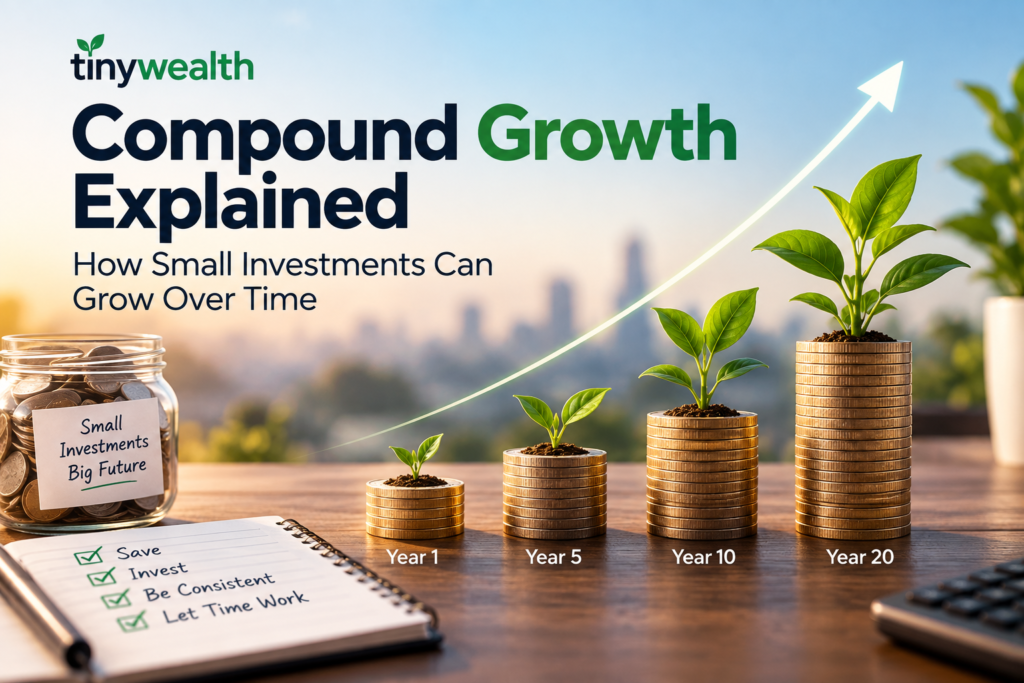
Compound growth is one of the most useful concepts for understanding long-term investing. Small contributions can become more meaningful when they are made consistently and returns remain invested over time.
But compounding is not a shortcut and it is not a promise of profit. A sound beginner approach still requires attention to risk, diversification, fees, inflation, taxes, affordability and time horizon. The goal is to understand how these pieces fit together before committing money to an investment.
Educational note: This article is for general informational purposes and is not personalised financial, investment, tax or legal advice. Investments can fall as well as rise, and you may lose money.
Further Reading
- Pound-Cost Averaging: How Regular Investing Works for Beginners
- What Is an Investment Time Horizon?
- Asset Allocation vs Diversification
- Investment Risk Explained for Beginners
- Micro-Investing Fees
A Simple £25-a-Month Example
Imagine a beginner contributes £25 a month to an investment for five years. Before considering any investment performance or fees, the total contributions would be £1,500.
- £25 × 12 months = £300 per year.
- £300 × 5 years = £1,500 contributed.
- The investment value after five years could be above or below £1,500.
If the investment earns positive returns and those returns remain invested, the account can potentially benefit from compounding. If markets fall, the account value can also be below the amount contributed. The contribution total is known; the future investment value is not.
What Is Compound Growth?
Compound growth happens when returns remain invested and future returns are earned on both the original money and previous returns. Investor.gov describes compound growth as earning a return on money invested as well as on the returns that money earns. The same basic idea can apply to savings interest, dividends that are reinvested, or investment gains that remain invested.
For example, suppose £100 grows by a hypothetical 5% in one year. It becomes £105. If the full £105 then grows by another hypothetical 5%, the second year’s increase is £5.25 rather than £5. The extra 25p comes from the previous year’s growth.
This example is purely illustrative. Investment returns are not fixed in the way a guaranteed savings rate might be, and a portfolio can also lose value.
Compound Interest vs Compound Growth
The terms are related but are not identical. Compound interest usually refers to interest being earned on the original principal and accumulated interest. Compound growth is a broader investing concept: an investment can generate returns through price appreciation, interest, dividends or a combination of sources.
For a beginner investor, the important idea is what happens when returns stay invested rather than being removed. If the investment produces no return in a particular period, there is no positive return to compound. If the investment falls, the effect works in the opposite direction.
Why Time Matters So Much
Compounding becomes more noticeable as the period grows because earlier returns have more time to generate additional returns. Investor.gov uses long-term investing examples to illustrate how regular contributions and time can work together.
Consider two hypothetical investors who both contribute £50 a month. The first contributes for five years; the second contributes for twenty years. They contribute the same monthly amount, but the second investor gives the money and any accumulated returns much longer to remain invested.
The exact outcome cannot be known in advance because investment returns change over time. The example demonstrates the role of time, not a promised investment result.
How Regular Contributions Change the Picture
Micro-investing often involves regular contributions, so compounding and recurring investing naturally fit together. Instead of investing one large amount, a person may add a smaller amount each week or month.
- Contribution: new money is added to the investment account.
- Investment: the money is used to buy the selected asset or portfolio.
- Return: the investment may gain or lose value, and it may produce income such as dividends or interest depending on the asset.
- Reinvestment: if returns or distributions are reinvested, those amounts can become part of the base on which future returns are generated.
- Time: the process can repeat over many years.
Regular investing does not remove market risk. It simply describes a contribution pattern. Our guide to pound-cost averaging explains how repeated purchases at different market prices work.