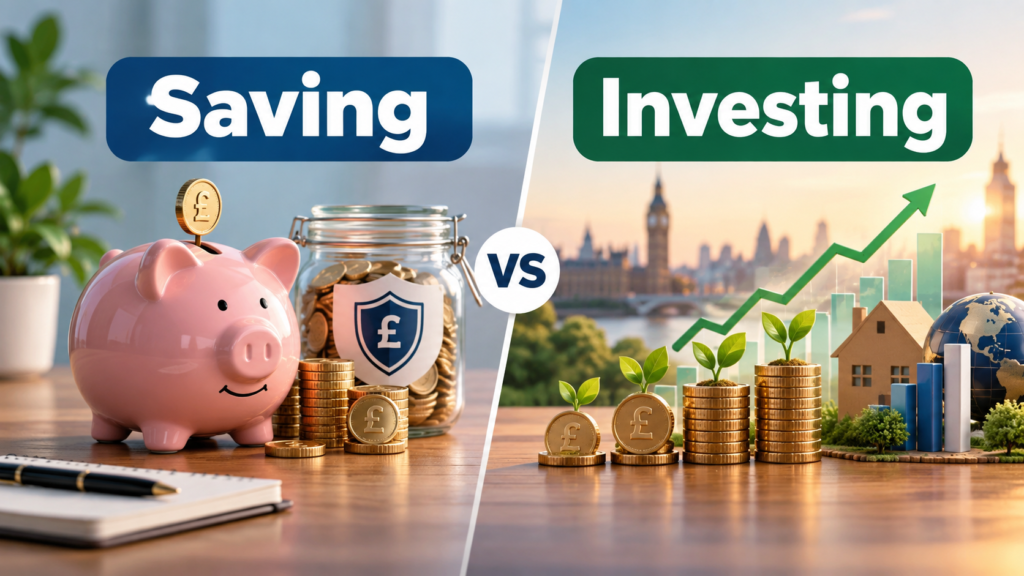

Saving and investing are both ways of putting money aside for the future, but they are designed for different jobs. Saving usually prioritises stability and access to cash. Investing accepts more uncertainty in exchange for the possibility of stronger long-term growth.
For beginners, the important question is not simply whether saving or investing is “better”. The more useful question is: when will you need the money, and how much risk can you afford to take?
What Is Saving?
Saving means setting money aside, typically in a bank or building society account, rather than spending it today. Savings are commonly used for emergency funds, planned purchases and goals where the money may be needed relatively soon.
The main advantages are accessibility and comparatively low risk. Depending on the account, you may be able to withdraw your money quickly, and eligible deposits with UK-authorised banks, building societies and credit unions may receive protection under the applicable deposit-protection rules.
However, cash has another risk: inflation. If prices rise faster than the interest earned on savings, the purchasing power of that money can fall over time.
What Is Investing?
Investing means putting money into assets such as shares, bonds or funds with the aim of generating a return over time. Unlike cash savings, the value of investments can rise and fall.
The Financial Conduct Authority (FCA) explains that higher potential returns generally involve greater uncertainty and risk. There is no guarantee that an investment will make money, and investors can receive back less than they put in.
This is why investing is normally approached as a longer-term activity rather than a place to keep money that may be needed next month or next year.
Saving vs Investing: The Main Differences
| Factor | Saving | Investing |
|---|---|---|
| Primary purpose | Preserve accessible money | Seek long-term growth or income |
| Risk | Generally lower | Value can rise or fall |
| Time horizon | Often short-term | Generally longer-term |
| Access | Can be quick, depending on account | May require selling investments |
| Return | Usually interest | Potential capital growth and/or income |
| Inflation | Can erode purchasing power | Potential to outpace inflation, but not guaranteed |
How Does Time Horizon Affect the Choice?
Time horizon is one of the clearest differences between saving and investing. MoneyHelper generally describes cash saving as more appropriate for short-term goals, while investing may be considered when the money will not be needed for a longer period.
The FCA notes that investing over a timeframe of at least five years can provide more opportunity to ride out short-term market fluctuations. This does not mean an investment held for five years is guaranteed to make a profit. It simply gives a longer period in which market movements can play out.
If you are unsure how this works, read our guide to investment time horizons.
Why an Emergency Fund Usually Comes Before Investing
Before investing, it is important to consider what would happen if an unexpected expense arrived tomorrow. If all available money is invested, an emergency could force you to sell at an inconvenient time, potentially when markets are down.
The FCA recommends having accessible emergency savings before investing. Its current beginner guidance uses at least three months of living expenses as a useful rule of thumb, while MoneyHelper commonly discusses an emergency buffer of roughly three to six months of essential expenses.
We explain this priority in more detail in Should You Build an Emergency Fund Before Investing?
Does Saving Mean There Is No Risk?
Saving avoids many of the price fluctuations associated with investments, but it is not completely free from financial risk. The most important long-term issue is inflation.
Suppose £1,000 remains in cash while the prices of everyday goods and services rise. Even if the balance remains £1,000, that money may buy less in the future. Interest can offset some or all of this effect, depending on the savings rate and inflation rate.
That is one reason people often use savings and investments for different parts of their financial plan rather than treating them as direct substitutes.
Does Investing Always Beat Saving?
No. Investments do not produce guaranteed returns. Markets can fall, individual investments can perform poorly and fees can reduce returns.
A savings account may therefore be more suitable for money that needs to remain stable and accessible. Investing may be considered for money that can remain committed for longer and where the investor understands and can tolerate the possibility of losses.
For a deeper look at downside risk, see Investment Risk Explained for Beginners.
Where Does Micro-Investing Fit?
Micro-investing does not change the basic distinction between saving and investing. It simply makes it possible to invest relatively small amounts, often through fractional shares, funds or regular contributions.
A £10 investment is still an investment. Its value can fall. The small contribution amount does not turn it into savings or remove market risk.
If you are starting with modest amounts, our micro-investing guide explains the fundamentals, while How Much Money Do You Need to Start Investing? looks specifically at starting capital.
Can You Save and Invest at the Same Time?
Yes. Saving and investing can serve different goals within the same financial plan. Someone might keep an emergency fund and money for near-term expenses in accessible savings while investing separate money intended for longer-term goals.
The appropriate balance depends on factors including income stability, debts, planned expenses, goals, time horizon and ability to tolerate investment losses.
A Simple Decision Framework
- You may need the money soon: prioritise accessibility and consider saving.
- The money is your emergency fund: keep it accessible rather than exposing it to investment-market movements.
- You have expensive or priority debts: consider dealing with those before committing money to investments.
- Your goal is several years away: investing may be worth researching if you understand and can tolerate the risks.
- You cannot afford a loss: do not assume investing is an appropriate substitute for cash savings.
- You are ready to invest: consider diversification, fees and your time horizon rather than focusing only on potential returns.
Saving, Investing and Compound Growth
Both savings and investments can benefit from compounding when returns remain in the account. With savings, interest can earn further interest. With investments, positive returns that remain invested can contribute to future growth.
Investment compounding is uncertain because returns can be positive or negative. Our guide to compound growth and small investments explains the concept with practical examples.
Frequently Asked Questions
Is saving safer than investing?
Cash savings are generally less exposed to market-price fluctuations than investments. However, inflation can reduce the purchasing power of cash, and account protections and terms should always be checked.
How long should money be invested?
There is no universal period that suits every person or investment. FCA guidance commonly discusses investing as a longer-term activity and notes that a timeframe of at least five years can help investors ride out short-term fluctuations.
Should I invest my emergency fund?
An emergency fund is intended to be available when unexpected costs arise. FCA guidance recommends keeping accessible emergency cash before investing rather than relying on investments for immediate financial emergencies.
Can I start investing with a small amount?
Depending on the platform and investment, yes. Fractional shares and regular-investment services can allow relatively small contributions. Fees and the underlying investment risk still matter.
Should beginners save before they invest?
Beginners should first consider their immediate finances, including essential expenses, debts and emergency savings. Whether additional money should then be saved or invested depends on the goal, timeframe and ability to tolerate losses.
Final Thoughts
Saving and investing are not competitors. They are tools for different financial needs.
Saving is particularly useful when stability, accessibility and shorter-term goals matter. Investing introduces more risk but can provide the possibility of stronger growth over longer periods. A sensible starting point is to match each pound to its purpose: money needed soon should not normally depend on unpredictable market performance, while money intended for the longer term may justify researching investments.
Educational note: This article provides general information only and is not personalised financial, investment, tax or legal advice. Investments can fall as well as rise, and you may get back less than you invest.