
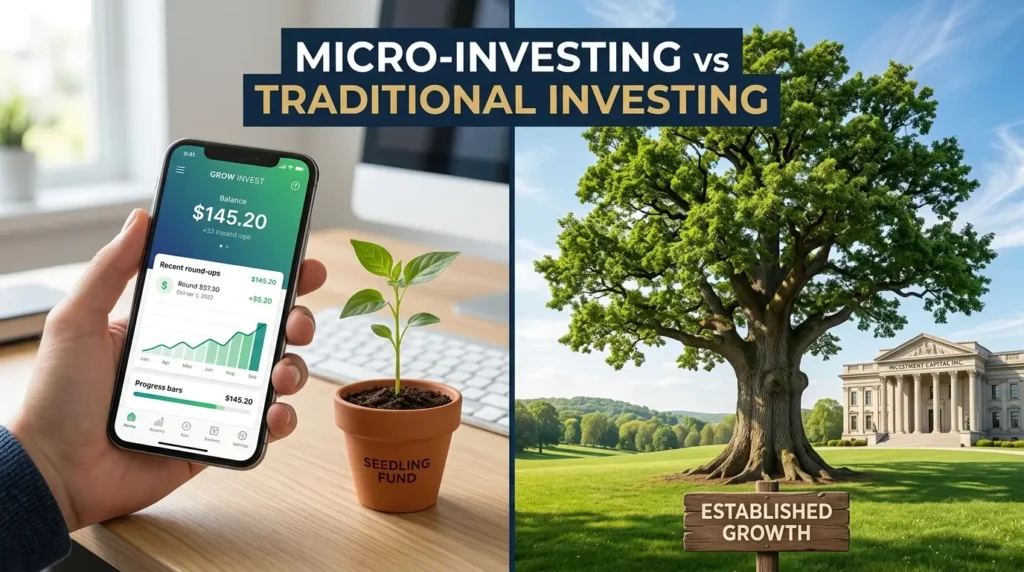

Micro-investing and traditional investing are not two separate asset classes. They are better understood as different ways of accessing and managing investments. Micro-investing usually emphasises smaller contributions, digital tools and, where supported, fractional ownership. Traditional investing can involve the same underlying assets through a broker, investment platform, fund provider or adviser.
The important question is therefore not which label sounds better. It is how the account works, what you can invest in, what it costs, what risks you take and whether the approach fits your financial goals.
Important: This article is educational information, not personalised financial advice. Investments can fall in value and you may get back less than you invest.
What Is Micro-Investing?
Micro-investing generally means investing relatively small amounts of money. A platform may support recurring contributions, round-up features, automated investing or fractional ownership.
The term describes the access and contribution model, not a guaranteed risk level. A £25 investment in a diversified fund can have very different characteristics from a £25 investment in one volatile company.
Read our What Is Micro-Investing? guide for the basic definition.
What Is Traditional Investing?
Traditional investing is a broad term rather than a single strategy. It can include buying individual shares, bonds, funds or other investments through established investment platforms, brokers, fund providers or financial advisers.
Traditional investing can also involve small contributions. The idea that traditional investing always requires a large lump sum is outdated because many modern platforms support small purchases and, in some cases, fractional ownership.
Micro-Investing vs Traditional Investing: The Core Differences
| Area | Micro-investing | Traditional investing |
|---|---|---|
| Typical contribution style | Often designed around smaller, recurring or automated contributions | Can support both regular contributions and larger lump sums |
| Technology | Usually strongly app- or automation-focused | May use a broker, platform, fund provider or adviser |
| Fractional ownership | May be a central feature where supported | Availability depends on the provider and investment |
| Investment range | Depends on the specific platform | Depends on the account and provider; can be broad |
| Minimum contribution | Often designed to support smaller amounts | Varies widely; some services also support small amounts |
| Automation | Often prominent | May be available, but is not defining |
| Risk | Depends on the underlying investments | Depends on the underlying investments |
| Fees | May include platform, product, transaction or FX costs | May include platform, product, transaction, advice or FX costs |
The table shows why the distinction should not be treated as a simple risk or return comparison. The same fund or share can potentially be accessed through different types of platforms.
How the Two Approaches Can Work
Micro-investing example
An investor might set up a recurring £25 contribution through a digital platform. If the platform supports fractional ownership, the £25 could buy part of an eligible security or fund. The investor may choose an automated portfolio rather than selecting every investment manually.
Traditional investing example
Another investor might transfer £500 to an investment account and choose a diversified fund, individual shares or a combination of assets. They might make further contributions monthly and review the portfolio periodically.
Both examples involve investing. The difference is mainly in the contribution size, platform experience and available features.
Investment Choice Matters More Than the Label
Two accounts can have very different risk profiles even if one is described as micro-investing and the other as traditional investing.
For example:
- A diversified fund may hold many securities and reduce dependence on one company.
- A portfolio concentrated in one company may be much more exposed to company-specific events.
- A bond fund, equity fund and individual share can behave differently even if all are available through the same app.
The FCA explains that diversification can reduce reliance on any one investment, while also stressing that diversification does not eliminate investment risk. FCA: Diversification
Are Micro-Investments Lower Risk?
Not automatically.
A smaller cash amount means fewer pounds are exposed to the investment, but it does not change the percentage movement of the asset. If an investment falls 30%, a £20 holding falls to roughly £14 before fees and other effects, while a £2,000 holding falls to roughly £1,400.
The FCA notes that higher potential returns generally involve greater uncertainty and that investors should understand the risks they are taking. FCA: Risk and returns
Costs and Fees
Fees are important in both approaches. Potential costs include:
- platform or account fees
- fund management or product charges
- dealing or transaction costs
- foreign-exchange charges
- spreads or execution-related costs
- advice charges where an adviser is used
- transfer or withdrawal fees where applicable
Micro-investing can make a fixed fee more noticeable because the account balance may be small. Traditional investing can involve different costs depending on whether you use funds, individual securities or professional advice.
Do not compare platforms using a headline “£0 commission” claim alone. The total cost depends on the complete fee structure and the investments you use.
See our micro-investing fees guide for a detailed checklist.
Accessibility and Ease of Use
Micro-investing platforms often place a strong emphasis on simple interfaces, automation and recurring contributions. This can reduce the practical barrier to opening and using an investment account.
Traditional investment platforms can also be straightforward to use, but some provide a wider range of investments, research tools, account types and trading features. More choice can be useful, but it can also mean more responsibility for understanding what you are buying.
Ease of use should therefore not be confused with investment quality or safety.
Automation and Regular Investing
Automation can be useful for recurring contributions, portfolio rebalancing or other account functions. It can also reduce the temptation to make decisions based on every short-term market movement.
But automation does not remove investment risk. An automated system still invests according to its underlying portfolio or instructions.
Regular contributions are also not a guarantee of profit. They simply create a systematic way to add money over time.
Fractional Shares
Fractional shares are particularly relevant to micro-investing because they can allow a smaller cash amount to buy part of an eligible security.
However, fractional ownership rules vary. Check how the provider handles:
- order execution
- dividend payments
- voting rights
- transfers
- withdrawals
- eligible securities
- fees and spreads
Our fractional shares guide covers these issues separately.
Regulation and Provider Checks
For UK investors, checking the provider is an important part of choosing an investment service. The FCA says investors should check whether a firm is authorised for the service they are using and should not assume that authorisation means every activity or product offered by the firm is regulated.
You can use the FCA’s Financial Services Register to check firms and permissions.
Also remember that regulation does not stop investments from falling in value. It is part of the framework around the financial service, not a promise of investment performance.
Risk and Diversification
Risk should be assessed from the actual portfolio rather than the platform label.
Useful questions include:
- What investments do I actually own?
- How concentrated are those holdings?
- Could the value fall significantly?
- How easily can I access the money?
- What fees reduce my return?
- How long can I leave the money invested?
- Could I continue with the plan during a market decline?
Our micro-investing risks guide explores these risks in more detail.
Tax and Account Structure
The tax treatment of investing depends on the country, account type, investment and individual circumstances. UK investors should understand the account wrapper or structure they are using and keep appropriate records.
Do not assume that a micro-investing app has the same tax treatment as every other investment account. If your circumstances are complex, consider obtaining appropriate tax or financial advice.
Which Approach Fits a Beginner?
There is no universal answer because “beginner” does not describe someone’s financial position, goals or risk tolerance.
A person with £20 available each month might value a platform that supports small recurring contributions. Another person with a larger portfolio might prefer a broader investment account with additional asset choices or research tools.
The more useful comparison is to ask whether the account:
- supports the amount you can afford to invest
- offers investments you understand
- has acceptable total costs
- provides the access and withdrawal arrangements you need
- supports appropriate diversification
- comes from a provider you can verify
Our micro-investing for beginners guide provides a practical starting framework.
Common Misconceptions
“Traditional investing always requires a lot of money.”
Not necessarily. Minimums vary by provider and product, and some traditional investment accounts support relatively small contributions.
“Micro-investing is safer because the amount is small.”
No. The amount invested changes the size of the potential pound loss, not the underlying percentage risk.
“Micro-investing always means automated investing.”
No. Some platforms offer automation, but the term itself does not guarantee that feature.
“A diversified portfolio cannot lose money.”
No. Diversification can reduce certain concentration risks, but a diversified portfolio can still fall in value.
“A £0 commission platform is free.”
Not necessarily. Other costs can include spreads, fund expenses, platform charges, foreign-exchange costs or other fees.
Frequently Asked Questions
What is the main difference between micro-investing and traditional investing?
Micro-investing usually focuses on smaller contributions and digital features such as automation or fractional ownership. Traditional investing is a broader category that can involve the same underlying investments through brokers, platforms, fund providers or advisers.
Is micro-investing lower risk?
Not automatically. Risk depends primarily on the underlying investments, diversification, time horizon, liquidity and other factors.
Can I use a traditional investment account with a small amount?
In many cases, yes. Minimums vary by provider and investment, so check the specific account terms.
Does micro-investing give better returns?
There is no general return advantage created by the micro-investing label. Returns depend on the investments, costs, market conditions and contributions.
Are fractional shares the same as whole shares?
Not necessarily. Fractional ownership can have provider-specific rules around execution, dividends, voting rights, transfers and other features.
How should I compare the two?
Compare the actual investments available, total fees, diversification, liquidity, provider status, account structure and the amount you can realistically invest.
Where This Fits in the TinyWealth Series
This comparison page sits between the broad micro-investing concept and the more specific practical guides:
- The Ultimate Guide to Micro-Investing — broad overview.
- What Is Micro-Investing? — definition.
- How Does Micro-Investing Work? — mechanics.
- How Much Money Do You Need to Start Investing? — starting amount.
- Micro-Investing Apps — platform evaluation.
- Micro-Investing Fees — costs.
- Micro-Investing Risks — risks.
Final Takeaway
Micro-investing and traditional investing overlap more than the labels suggest. Both can provide access to shares, funds and other investments, and both can involve small or large contributions depending on the provider.
The useful comparison is therefore practical: look at what you can invest in, how much you can afford to contribute, what it costs, how diversified the portfolio can be, how easily you can access your money and what risks you are taking.
TinyWealth provides educational information and does not provide personalised financial advice. Investment values can fall as well as rise, and you may get back less than you invest.



Very helpfull ….