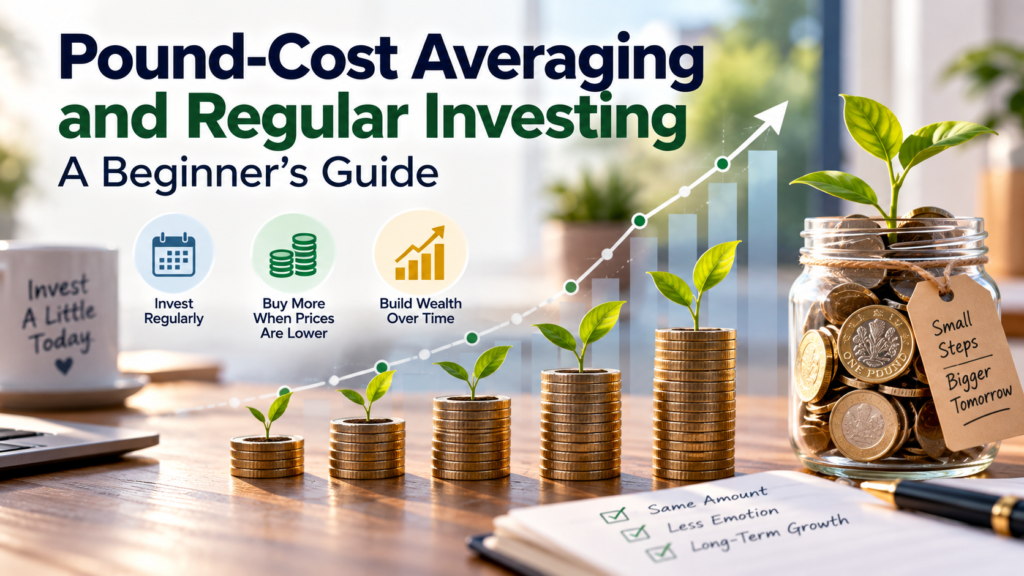

What is pound-cost averaging? Pound-cost averaging is a way of investing a fixed amount at regular intervals instead of trying to choose the perfect time to buy. When the investment price is lower, the same contribution buys more units; when the price is higher, it buys fewer. The approach can make regular investing more systematic, but it does not remove investment risk or guarantee a profit.
Important: This article is general financial education, not personalised financial, investment, tax or legal advice. Investments can fall as well as rise, and you may get back less than you invest.
How Pound-Cost Averaging Works
Imagine an investor contributes £100 each month to the same investment. The contribution stays constant while the investment price changes.
| Month | Price per unit | Contribution | Units bought |
|---|---|---|---|
| January | £20 | £100 | 5 |
| February | £25 | £100 | 4 |
| March | £10 | £100 | 10 |
| April | £20 | £100 | 5 |
Across these four months, the investor contributes £400 and buys 24 units. The number of units changes because the price changes. The investor does not need to predict which month will have the lowest price.
The FCA explains that regular monthly investing can help smooth the effect of short-term market movements because a fixed monthly amount buys more when prices are lower and less when prices are higher. Investor.gov describes the related dollar-cost-averaging approach as investing equal amounts at regular intervals regardless of market ups and downs.
FCA: The golden rules of investing · Investor.gov: Dollar-cost averaging
Why Do Investors Use Regular Investing?
It creates a repeatable process
Instead of making a new investment decision every time money becomes available, an investor can follow a regular contribution schedule. This can make investing easier to manage alongside a regular income.
It reduces the need to choose one purchase date
Short-term market movements are difficult to predict. A regular contribution approach means an investor does not need to identify one perfect day to buy.
It changes the number of units purchased automatically
With a fixed cash contribution, lower prices mean more units can be purchased and higher prices mean fewer. This is the basic mechanical feature behind pound-cost averaging.
It can fit a monthly budget
For someone investing from regular income, contributions can become part of a monthly financial routine. However, essential spending, appropriate emergency savings and other important financial commitments should be considered before investing.
Pound-Cost Averaging Does Not Mean “Buying at a Discount”
A common misunderstanding is that regular investing guarantees an attractive average purchase price. It does not.
The average price paid depends on the sequence of prices and the amount invested at each point. A falling market can mean more units are purchased with the same contribution, but the investment can still be worth less than the amount contributed. If prices continue falling, the portfolio can continue to lose value.
The strategy changes how contributions are made; it does not change the underlying risk of the investment.
Pound-Cost Averaging vs Investing a Lump Sum
| Approach | How it works | Main consideration |
|---|---|---|
| Regular investing | Invest a set amount at regular intervals | Reduces reliance on choosing one purchase date |
| Lump-sum investing | Invest available money in one or fewer transactions | More of the money is exposed to the market sooner |
If money becomes available gradually from a salary, regular investing may simply reflect the timing of the investor’s cash flow. If someone already has a large lump sum, deciding whether to invest it immediately or spread contributions over time is a different decision. The appropriate choice depends on circumstances, goals, risk tolerance, time horizon and the investment itself.
MoneyHelper recommends considering immediate financial priorities, emergency savings, debts and how long you can leave money invested before deciding how to invest spare cash.
MoneyHelper: Is investing for someone like you?
A Simple £100-a-Month Example
Suppose an investor contributes £100 each month for five months:
| Month | Price per unit | Contribution | Units purchased |
|---|---|---|---|
| 1 | £10 | £100 | 10 |
| 2 | £8 | £100 | 12.5 |
| 3 | £5 | £100 | 20 |
| 4 | £8 | £100 | 12.5 |
| 5 | £10 | £100 | 10 |
Total contributions are £500 and the investor owns 65 units. The example shows how a fixed contribution buys different quantities as prices change.
It does not show that the investor has made a profit. The final value depends on the investment’s current price, fees and any other applicable costs or income.
Potential Benefits
- Consistency: regular contributions create a repeatable process.
- Less dependence on market timing: the investor does not need to identify one perfect purchase date.
- Automatic response to prices: the same contribution buys more units at lower prices and fewer at higher prices.
- Budget compatibility: contributions can be aligned with regular income when affordable.
- Behavioural structure: a predefined process may reduce the temptation to make every decision based on short-term market news.
These are characteristics of the approach, not promises of better investment performance.
Risks and Limitations
It cannot prevent losses
The investment can fall in value regardless of how regularly money is added. The FCA explains that investments can rise and fall and that higher potential returns generally involve higher risk.
It does not make a risky asset safe
Investing £25 a month into one highly volatile company is still concentrated investing. A small contribution changes the amount of money at risk, not the nature of the underlying asset.
Fees still matter
Regular transactions can involve platform, dealing, fund or currency costs depending on the provider and investment. When contributions are small, fixed charges can represent a larger percentage of the contribution.
See Tinywealth’s guide to micro-investing fees for the costs beginners should check.
Regular investing is not automatically diversified
Buying the same single investment every month does not necessarily create a diversified portfolio. Diversification depends on what the investment actually holds. The FCA explains that spreading investments across different products and markets can reduce reliance on any single investment or area.
It is not an emergency-fund strategy
Money needed for unexpected expenses has a different purpose from long-term investment money. Tinywealth’s emergency-fund guide explains why accessible savings can be important before investing.
When Might Regular Investing Fit a Beginner’s Plan?
Regular investing can be a practical framework when someone has money available for a longer-term goal and wants a repeatable contribution process.
Before investing, consider:
- Are essential bills and short-term needs covered?
- Do I have appropriate accessible emergency savings?
- Have I considered high-interest debt?
- When might I need the money?
- Can I tolerate the investment falling in value?
- Do I understand what I am buying?
- What fees and charges apply?
- Is the portfolio appropriately diversified for my circumstances?
- Is the provider authorised where relevant?
The FCA’s investing guidance encourages investors to consider emergency savings, debt, time horizon, risk and costs before investing.
Pound-Cost Averaging and Micro-Investing
The two ideas can work together, but they are not the same thing.
Micro-investing describes investing relatively small amounts. Pound-cost averaging describes investing a set amount at regular intervals regardless of short-term price movements.
For example, someone could invest £25 every month through a platform that supports small contributions. The £25 is the small contribution, while the repeated monthly schedule is the regular-investing component.
Read Tinywealth’s guide to what micro-investing is and how micro-investing works for the wider context.
How to Build a Simple Regular-Investing Routine
- Define the goal. Know what the investment is intended to support.
- Choose an appropriate time horizon. Investing is generally more suitable for money that can remain invested for the longer term.
- Choose a sustainable contribution. Do not choose an amount that puts essential spending under pressure.
- Understand the investment. Check what assets you will actually own.
- Check diversification. Look beyond the number of funds or shares and understand their underlying holdings.
- Check costs. Review platform, transaction, fund and currency-related charges.
- Automate only when appropriate. Automation can create consistency, but it does not remove the need to review the investment.
- Review periodically. Reconsider your goals, circumstances, risk tolerance, investment and costs as they change.
Common Mistakes to Avoid
- Assuming pound-cost averaging guarantees profits.
- Thinking a small contribution means a low-risk investment.
- Ignoring platform or fund charges.
- Confusing regular investing with diversification.
- Investing emergency savings simply because the contribution is small.
- Choosing an investment without understanding what it owns.
- Reacting to every short-term market movement.
- Assuming every investment platform has the same fees, protections or features.
Frequently Asked Questions
Is pound-cost averaging the same as regular investing?
They are closely related. Regular investing means contributing on a recurring schedule. Pound-cost averaging describes the effect of investing a fixed amount at regular intervals while the investment price changes.
Does pound-cost averaging guarantee a lower average price?
No. The resulting average purchase price depends on the prices at which contributions are invested. The approach does not guarantee a profit or protect against losses.
Can I use pound-cost averaging with £10 or £20?
If the platform and investment allow contributions of that size, regular investing can be done with relatively small amounts. Check minimum contributions, dealing rules and fees before starting.
Is pound-cost averaging safer than investing a lump sum?
Not necessarily. It changes the timing of contributions rather than eliminating market risk. The appropriate approach depends on circumstances, available cash, time horizon and risk tolerance.
Does regular investing reduce investment risk?
It can change the effect of short-term price movements on a sequence of purchases, but it does not remove the risk that the underlying investment will fall in value.
Should I use regular investing for my emergency fund?
No. An emergency fund is intended to provide accessible money for unexpected needs, while investments are exposed to market risk. Keep emergency savings separate from long-term investment money.
Final Takeaway
Pound-cost averaging is best understood as a disciplined way of making regular investment contributions rather than a method for predicting markets. A fixed contribution buys more units when prices are lower and fewer when prices are higher, which can smooth the purchase process over time.
But the approach does not make an investment safe, guarantee returns or eliminate the need for diversification, cost checks and an appropriate time horizon. The most important question remains what you are investing in and whether the money can remain invested through market ups and downs.
For more beginner guidance, continue with Tinywealth’s Ultimate Guide to Micro-Investing, then review micro-investing risks, micro-investing fees and how much money you need to start investing.
Tinywealth provides general financial education and does not provide personalised financial, investment, tax or legal advice. Investment values can fall as well as rise, and you may get back less than you invest.