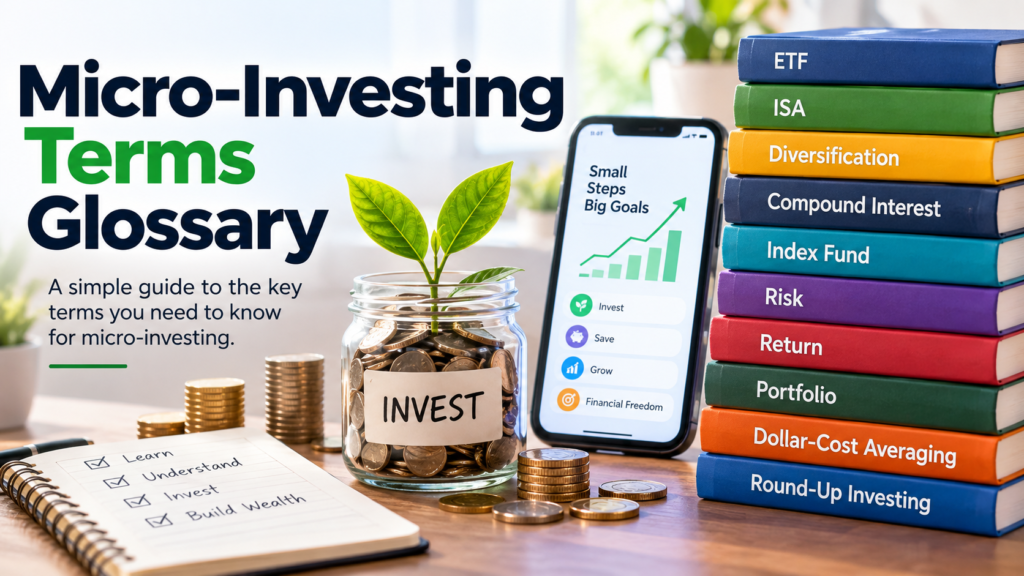

Micro-investing can make investing feel more approachable because you can start with small, regular amounts. But an app may introduce unfamiliar words such as fractional shares, ETFs, platform fees and diversification. Understanding these terms helps you know what you are buying, what it may cost and what could happen to your money.
This glossary explains key terms in plain UK English. It is general financial education, not a recommendation to buy a particular investment. Investment values can fall as well as rise, and you may get back less than you invest.
1. Micro-investing
Micro-investing means investing small amounts of money, often through an app or an online investment platform. Some services let users make recurring contributions or invest spare change from purchases. Small contributions can help build a habit, but they do not remove investment risk or guarantee a profit.
2. Fractional shares
A fractional share is less than one whole share in a company. Where a provider offers fractional investing, an investor may be able to invest a small sum instead of paying for a full share. Availability, voting rights, transfer rules and how fractions are held vary by provider, so check the platform’s terms.
3. ETF (exchange-traded fund)
An exchange-traded fund (ETF) is a fund traded on a stock exchange. Many ETFs hold a basket of investments, such as shares or bonds, and some track an index. An ETF can offer exposure to multiple holdings through one investment, but its value can still fall and not every ETF is broadly diversified.
4. Index fund
An index fund aims to follow the performance of a chosen market index. It may be structured as an ETF or as another type of fund. The index determines what the fund holds, so check which market or assets it tracks and whether the fund’s approach matches your understanding and risk tolerance.
5. Diversification
Diversification means spreading investments across different companies, asset types, sectors or regions rather than relying on one holding. It can reduce the impact of a poor result from a single investment, but it cannot eliminate losses when markets fall broadly. Read our guide to diversifying a small investment portfolio.
6. Investment risk and volatility
Investment risk is the possibility that an investment will not deliver the outcome you expect, including losing money. Volatility describes how much and how quickly an investment’s price moves over time. A volatile investment can rise sharply as well as fall sharply; recent performance does not reliably predict what happens next.
7. Capital
Capital is the money you put into an investment. If you invest £100, that £100 is your starting capital. The value can increase or decrease, and charges may also affect the amount remaining. You should not invest money you need for essential bills or urgent emergencies.
8. Returns
Return is the gain or loss on an investment over a period. It can include changes in the investment’s price and income, such as dividends or interest, where applicable. A positive return is not guaranteed, and the return shown before fees may be different from what you actually receive after costs and tax.
9. Compound growth
Compounding occurs when returns remain invested and can themselves generate future returns. Over long periods, that can help growth build on previous growth. Compounding also works in the opposite direction when losses occur, and real outcomes depend on market performance, charges, contributions and time. See our guide to compound growth.
10. Pound-cost averaging
Pound-cost averaging means investing a set amount at regular intervals instead of investing the whole amount at once. When prices are lower, a fixed contribution buys more units; when prices are higher, it buys fewer. It can make the timing of contributions more consistent, but does not guarantee a profit or prevent losses. Learn more in our pound-cost averaging guide.
11. Platform fee
A platform fee is a charge a provider may apply for holding or administering your investments. It might be a fixed amount or a percentage of your balance. A fixed monthly charge can take up a larger share of a very small portfolio, so compare the full cost with the amount you expect to invest. Our micro-investing fees guide covers common charges.
12. Fund charge or ongoing charge
A fund charge is a cost associated with running an investment fund. It is often expressed as a percentage per year and is normally reflected in the fund’s value rather than invoiced as a separate monthly payment. Different funds can have different charges, so read the fund documents and compare like with like.
13. Transaction fee and spread
A transaction fee is a charge related to buying, selling or carrying out a particular transaction. The spread is the difference between the price at which an asset can be bought and the price at which it can be sold at a given moment. The spread can be an indirect trading cost, even when a platform advertises commission-free dealing.
14. Dividend
A dividend is a payment a company may make to shareholders, usually from its profits. Not every company pays dividends, and payments can be reduced or stopped. Funds may distribute income or reinvest it, depending on the fund share class and product terms.
15. Asset allocation
Asset allocation describes how a portfolio is divided between categories such as shares, bonds and cash. The mix can influence how a portfolio behaves, but no allocation is risk-free or suitable for everyone. It should be understood in relation to a person’s aims, timeframe and ability to cope with losses.
16. Investment time horizon
Your time horizon is how long you expect to keep money invested before needing it. Money needed soon is generally less suited to assets that can change sharply in value. The FCA says investing over at least five years can give investments more opportunity to ride out short-term market fluctuations, but losses remain possible. Read our guide to investment time horizons.
17. Liquidity
Liquidity describes how easily an asset can be converted into cash without a significant impact on its price. An investment may be sellable through an app yet still take time to settle and withdraw. Check dealing hours, settlement timelines, withdrawal limits and any charges before relying on investments for near-term spending.
18. Risk tolerance
Risk tolerance is how comfortable you feel with uncertainty and the possibility of losses. Your ability to take risk is also affected by your financial circumstances: someone who needs the money soon may have less room to withstand a fall, even if they feel emotionally comfortable with risk.
19. Stocks and Shares ISA
A Stocks and Shares ISA is a UK tax-advantaged account that can hold eligible investments. The account wrapper does not make investments themselves safe or prevent their value from falling. Eligibility, annual rules and provider features can change, so check current official guidance before making a decision. This article does not provide personal tax advice.
20. FCA authorisation
The Financial Conduct Authority (FCA) is the UK conduct regulator for financial services. Before using an investment provider, check the firm and the specific activity on the FCA Register. Authorisation does not mean every product is protected, and it does not protect you from ordinary market losses. Read the FCA’s golden rules of investing for more guidance.
How to use this glossary before investing
- Identify what you will own. Find out whether the app offers shares, funds, ETFs or another product.
- Read the full cost details. Check platform charges, fund costs, transaction fees and any withdrawal or transfer fees.
- Understand the risk. Ask what could make the investment lose value and whether you could leave the money invested if markets fall.
- Check access to your money. Read the provider’s dealing, settlement and withdrawal rules.
- Verify the provider. Use the FCA Register and the provider’s official terms rather than relying only on an app-store description or social media post.
Frequently asked questions
Is micro-investing the same as saving?
No. Saving usually means keeping money in a savings account or another cash product, while investing means buying assets whose value can rise or fall. Cash savings and investments serve different purposes and carry different risks.
Are ETFs always diversified?
No. Some ETFs hold a broad range of investments, while others focus on a narrow sector, region or theme. Check the underlying holdings and index methodology rather than assuming every ETF spreads risk widely.
Can fees make a small investment unprofitable?
Charges reduce the money available to benefit from investment returns. Their effect depends on the fee structure, portfolio size and performance; a fixed charge can be particularly significant relative to a small balance. Compare costs before choosing a provider.
Does FCA authorisation mean my investment cannot lose money?
No. Investments can fall in value even when bought through an authorised firm. FCA status and compensation eligibility are different questions from the market performance of an asset.
The bottom line
You do not need to memorise every investing term before getting started, but you should understand the basics of what you own, what it costs, the risks involved and when you may need the money. Take your time, verify details with official sources and invest only when your finances and goals make it appropriate.
Disclaimer: Tinywealth provides general educational information, not personalised financial, investment, tax or legal advice. Investments can fall as well as rise, and you may get back less than you invest.