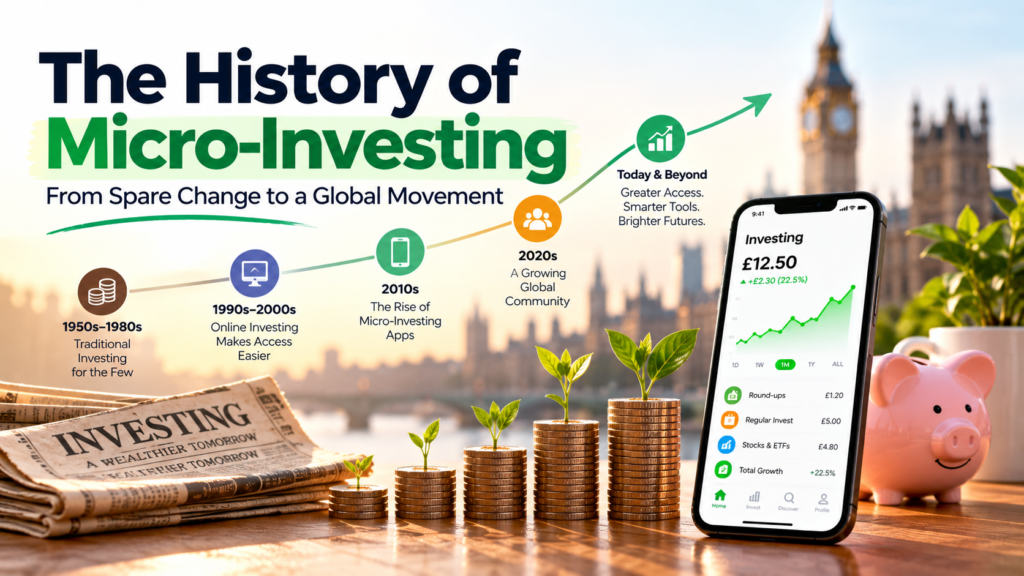

Micro-investing feels like a product of the smartphone era: tap a screen, invest a few dollars, and let automation do the rest. But the idea behind it is older than the apps themselves. For decades, investors have used recurring contributions, dividend reinvestment and pooled funds to put relatively small amounts of money to work.
What changed in the 2010s was the delivery. Smartphones, automated portfolios and fractional investing helped turn small-dollar investing from a relatively awkward process into something that could happen in the background of everyday life.
This history matters because it explains what micro-investing really is: not a new asset class, but a more accessible way to use familiar investing principles.
Important: This article is educational, not personalised financial advice. Investments can fall as well as rise, and you may lose money.
What Is Micro-Investing?
Micro-investing generally means investing relatively small amounts of money, often through an app or digital platform. Contributions might be made manually, automatically on a schedule, or through a round-up feature that sets aside the difference between a purchase and the next whole dollar.
The investments themselves are not necessarily unusual. Depending on the platform, money may ultimately be invested in exchange-traded funds (ETFs), shares or other securities. If you want the mechanics first, read our step-by-step guide to how micro-investing works.
Micro-Investing Did Not Begin With Smartphone Apps
The modern label is relatively new, but several ideas that made micro-investing possible existed long before smartphones.
Regular investing made small contributions practical
Investors have long been able to contribute money gradually rather than investing one large lump sum. Workplace retirement plans, recurring investment arrangements and other systematic approaches made consistency an important part of long-term investing.
Dividend reinvestment created fractional ownership
Fractional shares are often associated with modern investing apps, but they have older roots. FINRA notes that fractional shares historically appeared in dividend reinvestment plans, or DRIPs, because dividend payments often did not divide neatly into whole shares. In more recent years, fractional shares have become much more widely available and are now an important part of many micro-investing strategies.
Read our fractional shares guide for a deeper explanation of how fractional ownership works.
The Robo-Advisor Era Changed the Experience
A major step toward today’s micro-investing model came with automated digital investment management. Robo-advisors made it possible for investors to answer questions about their goals and risk tolerance and then have software help build and manage a portfolio.
This reduced some of the friction traditionally associated with constructing and maintaining a diversified portfolio. Instead of selecting every investment manually, a user could interact with a digital interface while portfolio allocation and rebalancing happened behind the scenes.
That automation created the technical foundation for an even simpler proposition: what if investing could happen automatically in tiny increments?
2014: Spare-Change Investing Reaches the App Store
One of the defining moments in modern micro-investing came in 2014. Acorns launched its mobile investing app on 26 August 2014 with a simple idea: link a debit or credit card, round everyday purchases up to the next dollar and invest the difference.
Instead of asking a beginner to decide when to transfer a larger sum into a brokerage account, the round-up model connected investing to behaviour that was already happening—spending.
The concept was easy to understand. If a purchase was $3.60, the app could calculate a $0.40 round-up. Once the accumulated amount met the platform’s investment threshold, the money could be invested according to the service’s portfolio process.
Acorns expanded to Android in October 2014 after its iOS debut. By its first anniversary in August 2015, the company reported that more than one million people had signed up. Those numbers helped demonstrate demand for a simpler, mobile-first way to start investing with small amounts.
Why Spare-Change Investing Caught On
The popularity of the model was not just about investing pennies. It addressed several psychological and practical barriers that can stop beginners from starting.
It lowered the perceived starting barrier
Traditional investing can feel as though it requires a large amount of capital. Micro-investing reframed the first step around amounts that felt more manageable.
It automated the decision
Instead of repeatedly asking, “Should I invest this month?”, automation could turn contributing into a background habit. The amount might be small, but the behaviour could become consistent.
It matched the smartphone experience
By the mid-2010s, consumers were already becoming comfortable using apps for banking, shopping and payments. Investing through the same type of interface made the process feel less remote.
It made progress visible
Mobile dashboards could show contributions, portfolio values and progress in a simple format. That feedback made investing feel more tangible to people who had never used a traditional brokerage platform.
Fractional Shares Helped Push Micro-Investing Further
Round-ups solved one problem—how to collect small contributions. Fractional shares helped solve another: how to invest a small dollar amount when a whole share might be expensive.
A fractional share represents less than one full share. If a stock costs $1,000 and a brokerage supports fractional investing, for example, a $100 investment could represent 0.1 share before considering execution details or other costs.
FINRA says fractional shares have become more widespread in recent years and are now an integral part of micro-investing strategies at a number of firms. Availability still varies by brokerage, and the rules for trading, transferring and handling fractional positions can differ.
Micro-Investing Expanded Beyond Round-Ups
As the category matured, “micro-investing” stopped meaning only spare-change round-ups. Modern platforms may support several ways to invest small amounts:
- automatic round-ups from everyday purchases;
- small recurring daily, weekly or monthly contributions;
- one-off small deposits;
- fractional purchases of eligible shares or ETFs; and
- automated portfolios built around an investor’s goals or risk profile.
FINRA’s current description of micro-investing reflects this broader model: small recurring transfers, purchase round-ups, low investment minimums and fractional shares can all be part of the approach.
From Investing Feature to Financial Ecosystem
Another important part of the history is how micro-investing companies broadened their products. What began as a simple investing feature increasingly became part of larger financial apps that could include retirement investing, children’s accounts, banking or cash-management tools, financial education and other services.
This evolution makes commercial models increasingly important. A platform may earn revenue through subscriptions, asset-based charges, underlying fund costs, foreign-exchange fees or other arrangements depending on the provider. Our guide to how micro-investing apps make money explains what to check.
A Short Timeline of Modern Micro-Investing
| Period | Development | Why It Mattered |
|---|---|---|
| Before smartphones | Regular investing and dividend reinvestment already allowed gradual investing and, in some cases, fractional holdings. | The underlying idea of putting small amounts to work was already established. |
| 2010–2011 | Consumer robo-advisors began bringing automated portfolio management online. | Software made diversified portfolio management easier to deliver digitally. |
| 2014 | Acorns launched its iOS app using automated spare-change round-ups and later expanded to Android. | Small-dollar investing became closely connected to everyday smartphone behaviour. |
| Mid-to-late 2010s | Mobile investing adoption expanded and app-based financial services became increasingly familiar. | Investing became more accessible to consumers who might not have opened a traditional brokerage account. |
| 2020s | Fractional investing, recurring investments and automated portfolios became widely available across digital brokers. | Micro-investing evolved beyond round-ups into a broader small-dollar investing model. |
What Actually Made Micro-Investing Mainstream?
No single technology created the category. Its growth came from several developments arriving together.
- Smartphones reduced friction. Account access, deposits and portfolio monitoring could happen from one device.
- Automation reduced decision-making. Recurring investments and round-ups made contributions easier to maintain.
- Fractional investing reduced purchase barriers. Investors no longer always needed enough cash for a whole share.
- Digital portfolio management simplified allocation. Automated services could handle tasks that once felt complex to beginners.
- Consumer expectations changed. People increasingly expected financial services to be fast, intuitive and available on demand.
What Has Not Changed
The interface changed dramatically. The fundamentals of investing did not.
A £10 or $10 investment is still exposed to the risks of whatever it owns. A small contribution does not make a volatile asset safe. An attractive app does not guarantee good returns. Automation does not remove market risk. And investing consistently does not mean every period will be profitable.
This distinction is especially important for beginners. See our guide to micro-investing risks and our explanation of whether micro-investing is worth it.
How Micro-Investing Changed Investor Behaviour
Perhaps the biggest contribution of micro-investing is behavioural rather than technological. It challenged the assumption that someone must first become wealthy before becoming an investor.
By lowering account minimums, automating contributions and presenting investing through familiar mobile interfaces, micro-investing platforms made it easier to begin with modest amounts. That can help people establish an investing habit earlier.
However, accessibility can also create new behavioural risks. Easy trading, constant account checking and gamified interfaces may encourage short-term decisions. The useful part of micro-investing is the lower barrier to disciplined investing—not the temptation to treat investing like entertainment.
Does Micro-Investing Build Wealth?
Micro-investing can contribute to long-term wealth building, but the word “micro” should not create unrealistic expectations. Outcomes depend on contribution size, investment returns, fees, diversification, taxes where applicable and, importantly, time.
Small contributions can become meaningful when they are consistent and have enough time to compound, but increasing contributions as income and financial capacity grow can matter enormously. See our guide to compound growth and small investments.
What Beginners Can Learn From the History
The history of micro-investing offers several useful lessons.
- The idea is evolutionary, not revolutionary. Small regular investments and fractional ownership have older roots.
- Technology mainly removed friction. Apps made established investing principles easier to access and automate.
- Convenience is not the same as safety. The underlying investments still determine much of the risk.
- Fees matter more when balances are small. A fixed subscription can represent a large percentage of a tiny portfolio.
- Habit formation is a major benefit. Automation can make consistent investing easier, provided the investment itself is suitable.
Frequently Asked Questions
When did micro-investing start?
There is no single start date because investing small amounts and owning fractional interests existed before modern apps. The smartphone-based micro-investing category became especially visible in the 2010s, with Acorns launching its spare-change investing app in 2014.
Who invented spare-change investing?
Modern app-based round-up investing is strongly associated with Acorns, which launched its mobile app in August 2014. The broader idea of investing small amounts, however, predates that app.
Are fractional shares a new invention?
No. FINRA notes that fractional shares historically appeared through mechanisms such as dividend reinvestment plans. What is newer is their widespread availability through consumer brokerage and micro-investing platforms.
Is micro-investing the same as a robo-advisor?
No. They can overlap. A robo-advisor generally uses software to recommend or manage a portfolio, while micro-investing refers more broadly to investing relatively small amounts. A micro-investing app may use a robo-advisor-style portfolio system.
Why did micro-investing become popular?
Smartphone access, automation, low minimums, fractional investing and simple user interfaces lowered practical and psychological barriers for new investors.
Final Thoughts
Micro-investing became mainstream by combining old investing principles with new technology. Regular contributions were not new. Fractional ownership was not entirely new. Diversified funds were not new. What changed was how easily all of those pieces could be packaged into a smartphone experience.
The spare-change apps of the 2010s helped make the first investment feel smaller and simpler. Since then, the category has expanded into recurring investments, fractional shares and broader automated financial platforms.
For beginners, the lasting lesson is straightforward: technology can make investing easier to start, but it does not change the fundamentals. Understand what you own, what you pay, how much risk you are taking and whether the investment fits your time horizon.
TinyWealth provides general educational information and does not provide personalised financial advice. Investments can fall as well as rise, and you may get back less than you invest.