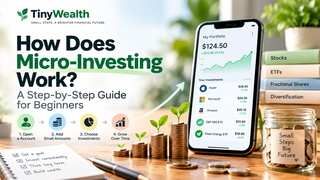

Micro-investing can look simple from the outside: put a small amount of money into an investment account and let it grow over time. But what actually happens between depositing £10 or £25 and owning an investment? The answer involves an investment account, available securities, order execution, recurring contributions, and—on some platforms—fractional shares.
This guide explains the process step by step, without treating micro-investing as a separate or automatically safer type of investment. The “micro” part generally describes the relatively small amount being invested or the tools that make small investments practical. The underlying investment still carries its own risks.
What Happens When You Micro-Invest?
At a basic level, micro-investing follows the same core process as other investing:
- You open an eligible investment account.
- You add money to the account.
- You choose an investment or portfolio.
- Your platform places an order or invests according to its process.
- You receive ownership of the relevant investment, which may be a whole or fractional share depending on the service.
- You monitor the account and manage contributions or withdrawals according to your plan.
The exact mechanics vary between providers. Some platforms offer self-directed investing, while others use managed portfolios. Some support fractional shares; others do not. Before using a platform, check its current terms, investment choices, fees, execution practices and withdrawal rules.
Step 1: Open an Investment Account
The first step is usually opening an account with a brokerage, investment platform or other authorised provider. The provider may ask for identity information, financial details and other information required by its onboarding process.
For UK investors, it is important to check whether the firm is authorised and whether the service being offered is covered by the relevant regulatory framework. The FCA recommends checking firms through its Financial Services Register and being cautious with online investment opportunities that make unrealistic promises.
FCA: Online trading scams and how to protect yourself
Step 2: Add a Small Amount of Money
Once the account is available, you normally need to fund it before an investment can be purchased. Depending on the provider, you may be able to make a one-off deposit or set up recurring contributions.
For example, an investor might choose to contribute £10 each week or £25 each month. These are examples, not recommended amounts. The right contribution depends on the person’s budget, goals, emergency savings and other financial commitments.
Step 3: Choose What the Money Will Buy
Adding money to an investment account does not automatically tell you what to buy. Depending on the platform, you may choose individual shares, ETFs, funds or a managed portfolio.
This distinction matters because the risk of a small investment depends heavily on what sits underneath it. A £20 investment in one volatile company is different from £20 invested in a diversified fund. A small balance does not automatically mean low risk.
The FCA explains that diversification can reduce reliance on any single investment or market, although it cannot eliminate investment risk.
FCA InvestSmart: Diversification
Step 4: Understand Fractional Shares
Fractional shares are one of the technologies that can make micro-investing practical. Instead of buying one complete share, an investor can own less than one share of an eligible security.
For example, if an eligible share costs £200 and a platform allows fractional investing, an investor with £20 could potentially buy an interest equivalent to 0.1 of a share, subject to the platform’s rules and the actual execution price.
Not every provider offers fractional shares, and the available securities, minimum order sizes, order types, trading times, fees, dividends, voting rights and transfer rules can differ. The SEC’s Investor.gov guidance highlights these differences and recommends checking how a particular brokerage handles fractional orders.
Investor.gov: Fractional Share Investing
Step 5: Automate Recurring Contributions
Many modern investment platforms allow recurring contributions. Instead of remembering to make every deposit manually, an investor can set a schedule and amount, subject to the provider’s available features.
Automation can make a plan easier to follow, but it does not make the investment itself safer. The contribution still purchases whatever investment has been selected, and its value can rise or fall.
What Are Round-Ups?
Some apps use a round-up feature that links investing to everyday spending. For example, a £3.40 purchase could be rounded up to £4.00, with the £0.60 difference collected for saving or investing. The exact rules differ between providers, and some services may group several round-ups before investing them.
Round-ups can make small contributions feel automatic, but they should be understood as a contribution mechanism rather than a special investment strategy. The important questions remain: where does the money go, what does it cost, and what investment is ultimately purchased?
Step 6: The Platform Executes the Investment
After you place an investment instruction—or after an automated instruction is triggered—the platform needs to execute it. The exact process depends on the security and provider.
Fractional-share orders can be handled differently from whole-share orders. Investor.gov notes that some firms execute fractional orders directly while others aggregate customer orders before execution. This can affect when and how an order is filled.
A Simple Example
Imagine an investor decides to contribute £25 every month to a diversified investment available through their platform.
- Month 1: £25 is contributed and invested.
- Month 2: Another £25 is contributed and invested.
- Month 3: Another £25 is contributed and invested.
- Later months: The process continues according to the investor’s chosen schedule.
After three months, the investor has contributed £75 before considering investment gains, losses or fees. The market value of the account could be above or below £75. That difference is determined by the performance of the investments and the costs associated with the account.
What Happens to Your Money After You Invest?
Once the investment has been purchased, its value can change as the underlying market changes. If you own shares or a fund, the value shown in your account will generally move with the value of those holdings, subject to the platform’s pricing and reporting process.
If an investment pays dividends or other distributions, the platform may pay them to your account or reinvest them, depending on the investment and account settings. Fractional-share arrangements can have specific rules for dividends and corporate actions, so investors should read the provider’s terms.
How Do Fees Affect Micro-Investing?
Fees deserve particular attention when balances are small. A charge that looks minor in pounds can represent a larger percentage of a small investment balance.
Potential costs can include platform charges, trading costs, fund expenses, foreign-exchange charges, subscription fees or other account-related costs. The exact combination varies by provider and product.
The FCA has highlighted the importance of clear investment-cost information and notes that consumers can find it difficult to identify and compare the total cost of investing. Investors should therefore look beyond a headline claim such as “commission-free” and check the complete fee structure.
FCA: Investment platform costs and charges
Can You Withdraw the Money?
Generally, an investor can request a withdrawal or sell an investment, but the exact process depends on the account and provider. Selling an investment may take time to settle before the cash becomes available to withdraw.
Fractional shares can also have additional restrictions. For example, a provider may have specific procedures for selling or transferring fractional holdings. Check the platform’s current withdrawal and transfer terms before you invest money that you may need soon.
Micro-Investing Does Not Remove Investment Risk
This point is worth repeating because the word “micro” can create the wrong impression. Investing £10 instead of £1,000 changes the amount of money at stake, but it does not change the underlying market risk of the asset.
The FCA describes investment risk and return as closely connected: investments offering the possibility of higher returns generally involve greater uncertainty and the possibility of losses. Diversification can help manage some risks, but it cannot guarantee a profit or prevent losses.
FCA InvestSmart: Risk and returns
Common Beginner Mistakes
- Choosing an investment only because it is cheap: A low share price does not automatically make an investment attractive.
- Ignoring fees: Small recurring charges can accumulate over time.
- Assuming small amounts cannot lose money: They can. Market values can fall regardless of the starting amount.
- Over-trading: Easy-to-use apps can make frequent buying and selling feel effortless.
- Concentrating on one asset: Owning a few individual investments is not necessarily the same as being diversified.
- Investing money needed soon: Investments can fall when you need to sell them, so your time horizon matters.
Micro-Investing vs. Traditional Investing
Micro-investing and traditional investing are not necessarily two completely different investment worlds. The same underlying shares or funds can sometimes be available through different types of platforms.
The practical differences may include minimum investment amounts, automation, fractional-share availability, platform features, investment selection, fees and account structure.
If you want the broader comparison, read our existing guide to micro-investing vs. traditional investing.
How to Think About Micro-Investing as a Beginner
A sensible starting point is to treat micro-investing as a method of accessing investments with smaller contributions—not as a shortcut to guaranteed wealth.
- Understand your budget before deciding how much to contribute.
- Learn what the platform actually invests in.
- Check every relevant fee and charge.
- Understand whether you are buying whole or fractional holdings.
- Consider diversification rather than focusing on one popular investment.
- Choose a time horizon that matches when you may need the money.
- Review your plan periodically instead of reacting to every market movement.
Frequently Asked Questions
Does micro-investing mean investing every day?
No. Micro-investing can involve one-off small investments, weekly or monthly contributions, round-ups, or other schedules. The frequency depends on the platform and the investor’s plan.
Do all micro-investing platforms offer fractional shares?
No. Fractional-share availability varies by provider, security and jurisdiction. Always check the current terms before assuming a particular investment can be purchased fractionally.
Can micro-investing make you rich quickly?
There is no reliable shortcut from small investments to guaranteed wealth. Investment returns are uncertain, markets can fall, and fees reduce returns. Micro-investing is better understood as a way to make smaller investments practical.
Is micro-investing safer than normal investing?
Not automatically. Risk comes from the underlying investments and the way a portfolio is constructed. Investing a smaller amount can reduce the amount of money exposed, but it does not change the percentage risk of the underlying asset.
Final Thoughts
Micro-investing works by making the mechanics of investing accessible to smaller contributions. You fund an investment account, choose an eligible investment or portfolio, place or automate an investment instruction, and then own assets whose value can change over time.
The technology can make investing easier, but the fundamentals remain the same: understand what you own, know what it costs, consider diversification and risk, and invest according to your financial situation and time horizon.
Educational note: This article is for general informational purposes and is not personalised financial, investment, tax or legal advice. Investments can fall as well as rise, and you may lose money.
Continue the TinyWealth Series
Now that you understand the mechanics, explore the related guides:
- What Is Micro-Investing? — the core definition.
- Micro-Investing for Beginners — the practical starting checklist.
- How Much Money Do You Need to Start Investing? — how to choose an affordable starting amount.
- Micro-Investing Apps — platform selection checks.
- Fractional Shares — ownership and provider-specific rules.
- Micro-Investing Fees — the costs to look for.
- Micro-Investing Risks — the risks behind the process.