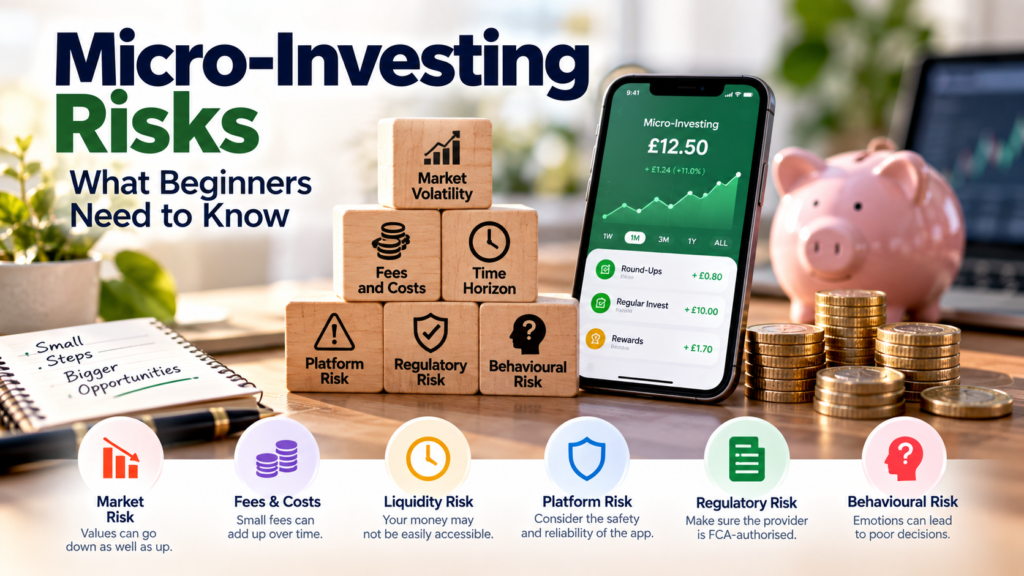

Micro-investing can make it easier to begin investing with a relatively small amount of money. But the smaller amount you invest does not make the underlying investment risk disappear.
If you buy shares, funds or other investments through a micro-investing app, the value of what you own can rise and fall. You may lose some or all of the money invested, depending on the investment and the circumstances. Investor.gov states that all investments involve some degree of risk, while the FCA explains that investment returns can be negative and that higher potential returns generally involve greater uncertainty. Investor.gov: What is Risk? | FCA: Risk and returns
This guide focuses on the risks that are especially useful for beginners to understand before using a micro-investing platform. It is educational rather than personal financial advice.
Does Micro-Investing Have Less Risk?
Not automatically.
Micro-investing describes a way of investing relatively small amounts. It does not describe a particular asset class with a fixed level of risk.
For example, two people could each invest £25 through an app. One might buy a diversified fund, while another buys shares in a single company or a highly volatile asset. The amount invested is the same, but the underlying risks can be very different.
The key question is therefore not simply “How much am I investing?” It is also “What am I investing in, and what could happen to that investment?”
1. Market Risk
Market prices move. Shares and funds can lose value because of changes in company performance, economic conditions, interest rates, investor expectations, geopolitical events and many other factors.
If you invest £25 and the investment subsequently falls by 20%, the investment would be worth about £20 before considering any fees or other effects. A small starting amount limits the pounds at risk, but it does not change the percentage movement of the investment.
Market risk is one reason investing money you may need immediately can be inappropriate for a particular goal. Your time horizon matters because you may not have enough time to wait through a market decline before you need the money.
2. Individual Investment Risk
Owning one company or a narrow investment exposes you to factors specific to that investment.
A company can experience weaker sales, higher costs, management problems, legal issues, competitive pressure or other events that affect its value. Investor.gov notes that with a stock, your financial outcome depends on the performance of the company you own. Investor.gov: Introduction to Investing
Micro-investing apps can make it easy to buy fractional shares, but owning a fraction of a risky investment does not make that investment less risky.
3. Concentration Risk
Investing small amounts does not automatically mean you are diversified.
If your entire £100 portfolio is invested in one company, you remain exposed to that company’s performance. If the company performs badly, most or all of the portfolio can be affected.
Investor.gov describes diversification as spreading money among different investments so that poor performance from one investment may have less impact on the overall portfolio. Diversification can reduce certain risks, but it cannot guarantee that a portfolio will not lose money. Investor.gov: Asset Allocation and Diversification
4. Diversification Does Not Eliminate Risk
Diversification is useful, but it is not a guarantee against losses.
Different investments can fall at the same time, particularly during broad market declines. A diversified portfolio can still lose value.
Also, buying several funds does not necessarily mean you are well diversified. Two funds may own many of the same companies or focus on the same sector.
The goal is to understand what you actually own rather than counting the number of investments in your account.
5. Volatility Risk
Some investments experience much larger price movements than others. This is often described as volatility.
A volatile investment can rise quickly, but it can also fall sharply. Large short-term price movements can be particularly difficult for investors who may need their money soon or who are uncomfortable with temporary losses.
The FCA explains that the relationship between risk and potential return is important: higher-risk investments can involve greater uncertainty, and taking more risk does not guarantee a higher return. FCA: Risk and returns
6. Liquidity Risk
Liquidity describes how easily an investment can be bought or sold without materially affecting its price or incurring significant costs.
An investment may be difficult to sell when you want to access your money. Even where an app allows you to press a “sell” button, the underlying investment may still be subject to market conditions, trading hours, settlement processes or other restrictions.
Investor.gov lists liquidity among the factors investors should consider when evaluating an investment product. Investor.gov: Investment Products
7. Inflation Risk
Inflation can reduce the purchasing power of money over time.
This creates an important distinction between losing money in nominal terms and losing purchasing power in real terms. An investment that grows slowly may still fail to keep pace with rising prices.
Inflation risk does not mean you should automatically choose a higher-risk investment. It means that when thinking about a long-term goal, you need to consider what your money may be able to buy in the future.
8. Currency Risk
If your investment is exposed to another currency, changes in exchange rates can affect the value of your investment when measured in your home currency.
For example, an overseas investment can increase in its local currency while the exchange rate moves against you. The opposite can also happen.
If a micro-investing platform provides access to overseas assets, check how currency conversion works and whether additional costs apply. Our guide to micro-investing fees covers currency conversion and other costs in more detail.
9. Fee and Cost Risk
Fees do not usually appear on an investment risk scale, but they can still affect your outcome.
Platform charges, transaction costs, fund expenses and currency-conversion costs can reduce the amount of money that remains invested or the return you ultimately receive.
This can matter more when your portfolio is small. A fixed fee can represent a larger percentage of a £25 contribution than it would of a £500 contribution.
See our dedicated guide to micro-investing fees for a detailed breakdown of the costs beginners should check.
10. Platform and Provider Risk
Micro-investing depends on an investment platform or provider to operate the account, process transactions and maintain records.
Before using a provider, understand who operates the service, which legal entity holds your account or assets, what protections may apply, and what happens if the provider experiences financial or operational problems.
For UK investors, the FCA provides a Financial Services Register that can be used to check whether a firm is authorised or registered for the activities it carries out.
Do not assume that an app being available in an app store means that every service it provides is regulated or that your investment is protected against market losses.
11. Fractional Share Risks
Fractional shares can make it possible to invest a smaller amount in an asset that would otherwise require purchasing a whole share. But fractional ownership can come with additional terms that vary by provider.
Investor.gov notes that availability, eligible securities, order types, execution, voting rights, dividends, fees, liquidity and transferability can differ for fractional shares. The FCA has also highlighted the importance of firms clearly explaining matters such as ownership rights, fees, execution and transferability to consumers.
Read our fractional shares guide before assuming that a fractional share works exactly like a whole share.
12. Behavioural Risk
One of the less obvious risks of app-based investing is how easy technology can make it to trade frequently.
Price notifications, performance charts and fast execution can encourage investors to react to short-term market movements. Repeatedly buying and selling because of fear or excitement can make it harder to follow a long-term plan and may also increase costs.
The FCA’s work on trading apps has highlighted the importance of firms considering consumer behaviour and the way app design can influence investment decisions. This does not mean every app encourages harmful behaviour; it means investors should understand their own reactions to frequent market information.
13. Fraud and Scam Risk
Investment scams can target people regardless of how much they plan to invest.
Be particularly cautious about claims of guaranteed returns, unusually high returns with little or no risk, urgent requests to transfer money, or pressure to make a decision immediately.
The FCA advises investors to be cautious of opportunities that seem too good to be true and to check firms before investing. Investor.gov similarly identifies promises of high returns with little or no risk as a classic warning sign of investment fraud. FCA: Understanding high-risk investments
14. Goal and Time-Horizon Risk
An investment can be unsuitable for a goal even when the investment itself is legitimate.
Imagine you need £500 in three months for a known expense. If you invest that money in a volatile asset and the market falls immediately before you need it, you may have to sell at a loss.
For a longer-term goal, there may be more time to withstand market fluctuations. Investor.gov recommends considering your time horizon and risk tolerance when thinking about asset allocation. Investor.gov: Asset Allocation and Diversification
15. The Risk of Investing Money You Cannot Afford to Lose
Micro-investing can make investing feel affordable because each individual contribution may be small. But an investor should still consider whether the money is available for investment rather than needed for essential expenses or unexpected costs.
Investor.gov distinguishes investing from saving and notes that savings can be appropriate for short-term goals and emergency needs, while investments can fluctuate in value. Investor.gov: Introduction to Investing
The appropriate balance depends on the individual’s circumstances. This article does not set a personal emergency-fund amount or investment allocation because those decisions depend on factors such as income, expenses, debts, goals and time horizon.
Micro-Investing Risks at a Glance
| Risk | What it means | What to check |
|---|---|---|
| Market risk | Investment values can fall | What assets are you buying? |
| Individual investment risk | One company or asset can perform poorly | How dependent are you on one investment? |
| Concentration risk | A narrow portfolio can be heavily affected by one area | What does the portfolio actually hold? |
| Volatility | Prices can move sharply | Could you tolerate a significant short-term fall? |
| Liquidity risk | An investment may not be easy to sell when needed | How and when can you access the money? |
| Inflation risk | Purchasing power can fall over time | What is the goal and time horizon? |
| Currency risk | Exchange rates can affect returns | Are overseas currencies involved? |
| Fee risk | Costs reduce investment outcomes | What is the total cost? |
| Provider risk | Platform or operational problems can create complications | Who operates the service and what protections apply? |
| Fraud risk | Scammers can target investors | Is the firm authorised and are the claims realistic? |
| Behavioural risk | Emotional decisions can undermine a plan | Are you reacting to short-term price moves? |
How Beginners Can Think About Risk Before Investing
You do not need to predict the market to start learning about investment risk. A practical review can begin with a few questions:
- What is the money for? Identify the goal before choosing an investment.
- When might I need the money? Consider the time horizon.
- What exactly am I buying? Understand the investment rather than choosing only because it is available in an app.
- How much could the value fall? Consider possible losses, not just expected returns.
- Am I diversified? Check what you actually own and whether several investments overlap.
- What will it cost? Check platform, transaction, fund and currency-related costs.
- Can I access the money when I need it? Consider liquidity and withdrawal arrangements.
- Is the provider authorised where relevant? For UK services, check the FCA Register.
- Could I stay invested during a market decline? Think about your own tolerance for volatility.
Risk Is Different From a Guaranteed Outcome
It is important not to turn risk management into a promise of safety.
Diversification can reduce some portfolio risks, but it cannot guarantee profits. A long time horizon can provide more opportunity to withstand market fluctuations, but it cannot guarantee a positive return. A regulated platform can provide a regulatory framework, but regulation does not prevent investments from falling in value.
The purpose of understanding risk is to make the possible outcomes clearer before investing, not to eliminate uncertainty.
How This Fits Into the TinyWealth Micro-Investing Series
This article is part of TinyWealth’s core micro-investing cluster. It focuses specifically on risk, while the related guides cover the definition, mechanics, starting amounts, platform selection, fees and fractional shares.
If you are new to the subject, start with What Is Micro-Investing? and then read How Does Micro-Investing Work?. You can also compare the approach with traditional investing in our micro-investing vs traditional investing guide.
For practical beginner decisions, see Micro-Investing for Beginners, Micro-Investing Apps, Fractional Shares and Micro-Investing Fees. If you are deciding how much to invest, see How Much Money Do You Need to Start Investing?.
Frequently Asked Questions
Is micro-investing low risk?
Not necessarily. Micro-investing refers to investing relatively small amounts, not to a specific level of investment risk. The risk depends heavily on the assets, diversification, time horizon and other factors.
Can I lose all the money I put into micro-investing?
Depending on the investment, it is possible to lose some or all of the money invested. The risk varies by investment product. High-risk investments can carry particularly significant loss potential.
Does diversification guarantee that I will not lose money?
No. Diversification can reduce the impact of poor performance from an individual investment or sector, but a diversified portfolio can still fall when markets decline.
Are fractional shares safer than whole shares?
No. A fractional share represents a smaller ownership amount, but the underlying investment can still rise or fall. Fractional ownership can also have provider-specific terms around execution, dividends, voting rights and transferability.
How can I check whether a UK investment platform is authorised?
You can search the FCA Financial Services Register for the relevant firm and check that the activities you are considering are covered. Also be alert to clone firms and misleading claims.
Should beginners avoid investing because of these risks?
Risk is a fundamental part of investing rather than something that can simply be removed. The useful approach is to understand the investment, the possible losses, the costs, the time horizon and the provider before committing money.
Final Thoughts
Micro-investing can reduce the amount of money needed to begin investing, but it does not remove the fundamental risks of investing. A £10, £25 or £100 investment can still fall in value, and the percentage risk of the underlying asset does not disappear because the amount is small.
For beginners, the strongest foundation is understanding what you own, why you own it, how diversified it is, what it costs, how easily you can access the money, and whether the investment matches your time horizon and tolerance for loss.
Educational note: This article is for general educational purposes and is not personal financial advice. Investment values can fall as well as rise, and you may lose some or all of the money invested. Regulations, platform terms, fees and available products can change. Check current information directly with the relevant provider and regulator before making an investment decision.