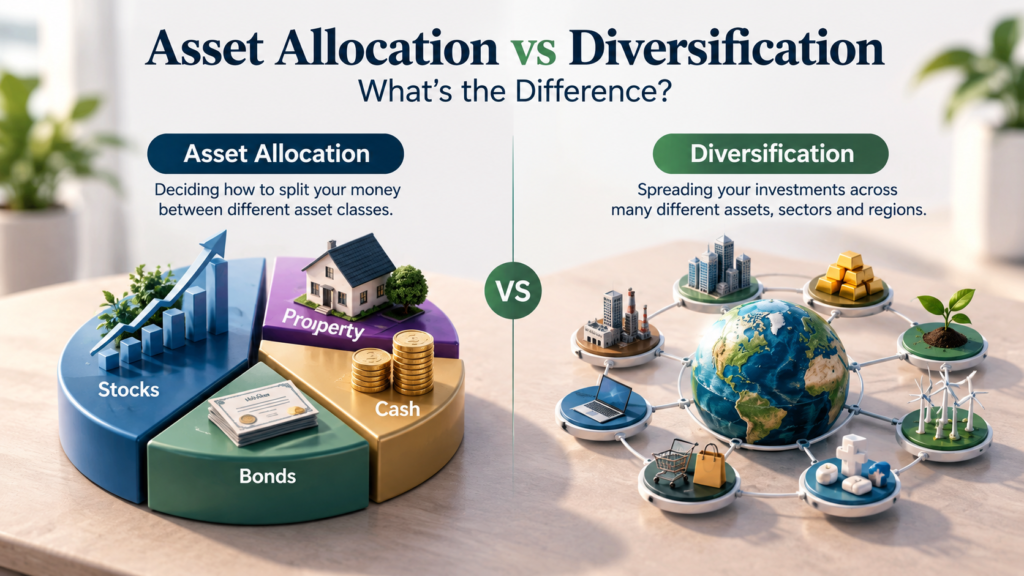

Quick answer: Asset allocation and diversification are related, but they are not the same thing. Asset allocation is about how a portfolio is divided among broad asset classes, such as shares, bonds and cash. Diversification is about spreading money across different investments so the portfolio is not overly dependent on one company, sector, market or other source of risk.
A portfolio can have an asset allocation and still be poorly diversified. For example, someone could allocate 100% of their portfolio to shares but hold a broad collection of companies and sectors. Conversely, someone could hold shares, bonds and cash but have concentrated exposure within one sector or one company.
Understanding the difference is useful for beginners because it helps separate two questions that are often mixed together: what types of assets do I own? and how concentrated are my investments within those assets?
What Is Asset Allocation?
Asset allocation means dividing an investment portfolio among different asset classes. Common categories include shares, bonds and cash, although investors may also use other asset classes depending on their goals and circumstances.
Investor.gov explains that the asset allocation that may be appropriate can change according to factors such as an investor’s time horizon and risk tolerance. That means there is no universal allocation that is automatically right for every person or every financial goal. citeturn0search0turn0search2
Think of asset allocation as the portfolio’s broad structure.
| Asset class | What it represents | Typical consideration |
|---|---|---|
| Shares / stocks | Ownership interests in companies | Can offer growth potential but prices can fluctuate significantly |
| Bonds | Debt issued by governments or companies | Can provide interest income but still carry investment and credit risks |
| Cash / savings | Money held in cash or cash-like accounts | Useful for liquidity and shorter-term needs, but inflation can reduce purchasing power |
The table is a simplified educational framework, not a recommended portfolio allocation. The appropriate mix depends on the goal, time horizon and circumstances.
What Is Diversification?
Diversification means spreading investments across different exposures so that the outcome of the portfolio is not dominated by one investment or one narrow source of risk.
Investor.gov describes diversification as spreading money among different investments to reduce risk. It also points out that diversification can happen both between asset classes and within asset classes. citeturn0search0turn0search4
The FCA similarly explains that diversification involves spreading investments across different products and areas so an investor is less dependent on any one investment performing well. citeturn0search12
So diversification is better thought of as the distribution of risk inside the portfolio.
Asset Allocation vs Diversification: The Key Difference
| Question | Asset allocation | Diversification |
|---|---|---|
| What does it focus on? | Broad asset classes | Different investments and exposures |
| Main question | What types of assets do I hold? | How concentrated are those holdings? |
| Can it exist without the other? | Yes | Yes |
| Can it reduce concentration risk? | Potentially, depending on the mix | Yes, this is a central purpose |
| Does it guarantee lower losses? | No | No |
The two ideas often work together, but they answer different questions.
Example: A Portfolio Can Be Allocated but Not Well Diversified
Imagine a beginner has a portfolio divided between shares, bonds and cash.
At first glance, that looks diversified across asset classes. But suppose most of the share allocation is concentrated in a single technology company, while the bond allocation consists of bonds from one issuer.
The portfolio has an asset allocation, but it still contains meaningful concentration risk.
This is why simply counting asset classes is not enough. You also need to understand what sits underneath each category.
Example: A Portfolio Can Be Diversified Within One Asset Class
Now consider a portfolio invested entirely in shares. It may still be diversified within the share allocation if it provides broad exposure across many companies, industries and regions.
This does not mean the portfolio has low overall risk. Share prices can fall across a broad market at the same time. But the investor is not relying on one company or one narrow sector for the entire outcome.
Investor.gov notes that investors can diversify within asset classes by spreading investments across different companies and industry sectors. citeturn0search0turn0search8
Why the Difference Matters for Beginners
Beginners often make one of two mistakes.
Mistake 1: Assuming several asset classes automatically mean diversification
Owning shares, bonds and cash does not automatically mean that every part of the portfolio is diversified. You still need to look at the holdings inside each category.
Mistake 2: Assuming a broad investment automatically solves asset allocation
A diversified share fund may provide broad exposure within equities, but it does not automatically decide how much of your overall portfolio should be in shares, bonds or cash.
That distinction becomes particularly important when different investments have different roles in a financial plan.
Where Funds and ETFs Fit In
Funds and exchange-traded funds can make diversification easier because one investment may provide exposure to many underlying securities.
However, a fund is not automatically diversified. Investor.gov specifically warns that a narrowly focused fund or ETF may remain concentrated, and investors should check the fund’s underlying holdings rather than relying only on the fund name. citeturn0search0
For example, a broad-market fund and a single-sector fund are both funds, but their diversification characteristics can be very different.
How This Connects to Micro-Investing
For small investors, the distinction is especially useful because limited capital can make concentration easier to overlook.
Fractional shares can allow an investor to buy a portion of a share rather than a whole share, but access to fractional shares does not automatically create diversification. What matters is the underlying exposure.
Tinywealth’s fractional shares guide explains how fractional ownership works, while the small portfolio diversification guide focuses on managing concentration across a smaller portfolio.
Micro-investing can therefore be a mechanism for investing small amounts; asset allocation and diversification remain separate decisions about how those investments are structured.
How Regular Investing Fits Into the Picture
Regular investing is another concept that should not be confused with either asset allocation or diversification.
Regular investing describes the process of adding money over time. Asset allocation describes how the portfolio is divided among asset classes. Diversification describes how investment exposures are spread.
These concepts can work together. For example, a person making regular contributions could direct new money toward an underrepresented part of their existing portfolio instead of automatically adding to the largest holding.
Tinywealth’s guide to pound-cost averaging explains the mechanics and limitations of regular investing in more detail.
What Is Rebalancing?
Rebalancing is the process of bringing a portfolio back toward an intended asset allocation after market movements or new contributions have changed its proportions.
For example, suppose a portfolio was originally structured with a certain mix of shares and bonds. If shares rise substantially while bonds do not, the portfolio may become more heavily weighted toward shares than originally intended.
Investor.gov explains that some investors rebalance when allocations move beyond a predetermined range, while others review on a calendar basis. It also notes that rebalancing can involve transaction costs or tax consequences depending on the circumstances. citeturn0search0turn0search2
There is no universal rebalancing schedule that is appropriate for every investor. The important principle is to understand how the portfolio has changed before making a decision.
A Simple Framework for Reviewing Your Portfolio
You can separate the review into three questions:
- Asset allocation: What proportion of the portfolio is in each major asset class?
- Diversification: Within each asset class, am I too dependent on one company, sector, market or theme?
- Alignment: Does the portfolio still make sense for the goal, time horizon and level of investment risk I am prepared to accept?
This framework can reveal problems that are difficult to see when you simply look at the number of investments you own.
Asset Allocation and Diversification Checklist
- List your major asset classes.
- Check what sits underneath each asset class.
- Look for one-company concentration.
- Look for sector concentration.
- Review geographic exposure.
- Check whether different funds hold many of the same investments.
- Consider how your portfolio has changed as markets moved.
- Understand the costs and potential tax consequences before buying or selling.
- Keep short-term emergency money separate from money intended for long-term investment where appropriate.
The Bottom Line
Asset allocation and diversification are complementary, not interchangeable.
Asset allocation asks where your money is placed across broad asset classes. Diversification asks how widely your investments are spread within and across those categories.
For beginners, understanding both concepts can make portfolio decisions easier to evaluate. You do not need a complicated portfolio to apply the principles. Start by understanding what you own, how concentrated it is, and how that structure relates to your financial goal and time horizon.
Diversification can help manage concentration risk, but neither diversification nor a particular asset allocation can guarantee profits or prevent losses. All investments involve risk.
Educational note: This article is for general financial education and is not personal investment, tax or financial advice. The appropriate portfolio structure depends on individual circumstances, goals, time horizon and tolerance for loss. Consider researching investments carefully and seeking regulated professional advice where appropriate.