
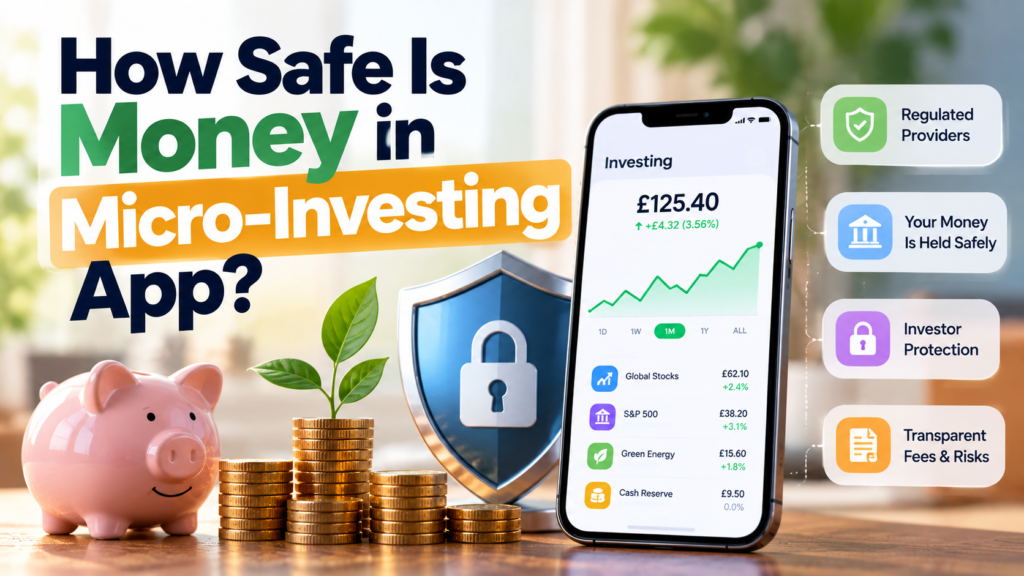

Micro-investing apps make investing accessible with small deposits, but a simple interface does not mean your money is automatically safe. Before using a UK investment app, you need to understand three separate questions: can your investments fall in value, who safeguards your assets, and what happens if a regulated firm fails?
The short answer is that investment losses are possible, UK custody rules may help protect your ownership rights, and Financial Services Compensation Scheme (FSCS) protection may apply to eligible losses following a firm’s failure. These protections are not interchangeable.
Is money in a micro-investing app safe?
There is no blanket guarantee. The outcome depends on the investment, the legal firm providing the service, where your cash and assets are held, and which regulated activity is involved. A £10 holding in a volatile share carries exposure to the share’s price movements, even if your contribution is tiny.
For a primer on market volatility and other risks, read our micro-investing risks guide. This article focuses specifically on asset custody, provider failure and consumer protection, rather than duplicating every type of investment risk.
Three different meanings of ‘safe’
| Question | What helps? | What is not guaranteed? |
|---|---|---|
| Will my investment keep its value? | Understanding the investment, timeframe and diversification | Share or fund prices can fall |
| Are my assets kept separate from the platform’s own assets? | Applicable FCA client-asset and custody rules | No system eliminates administration, recordkeeping or fraud risks |
| Will I be compensated if a financial firm fails? | FSCS, where the claim and firm are eligible | Not every loss, activity or firm qualifies |
What are FCA custody rules?
For firms and activities to which the rules apply, the FCA’s Client Assets Sourcebook (CASS) sets obligations designed to safeguard clients’ ownership rights. For example, CASS 6.2 requires appropriate arrangements to safeguard safe-custody assets, particularly if the firm becomes insolvent, and to minimise risks such as misuse, poor administration and inadequate recordkeeping.
That does not mean the app itself must hold every share directly. Depending on the arrangement, a custodian, nominee or another firm may hold securities on clients’ behalf. Read the platform’s legal and custody disclosures to learn which entities are involved.
What is a nominee account?
Investment platforms commonly use nominee arrangements to hold legal title to securities while keeping records of the underlying clients’ interests. This can streamline trading and administration, but it makes accurate recordkeeping and a clear custody chain essential. Do not assume that the word “nominee” itself guarantees compensation.
Are uninvested cash balances treated like investments?
Not necessarily. Uninvested cash may be held as client money, a deposit with a bank or under another arrangement depending on the provider and account. The legal structure determines what protections may apply. Always check where the cash actually sits before assuming it is covered as a bank deposit.
What happens if a micro-investing platform goes bust?
A firm failure does not automatically mean your underlying investments have disappeared. In appropriate custody arrangements, client holdings may still be identifiable and potentially transferable or returned. However, access may be disrupted while administrators reconcile records and investigate any shortfall.
The FCA explains that when a financial firm fails, customers may lose access to assets or face delays and may be eligible for compensation in particular circumstances. Review the FCA’s consumer guide to compensation following firm failure.
A hypothetical £250 example
Imagine you hold £250 of units in a fund through an app. If the app operator enters administration but its client asset records and arrangements are intact, the value of those fund units does not automatically become zero. There may be a process to return or transfer them. By contrast, if records are deficient or assets are missing, the situation could be more complicated. The result depends on the individual facts and applicable rules.
How much FSCS protection is available for investments?
As at October 2026, the FSCS limit for eligible protected investment-business claims is generally up to £85,000 per person per authorised firm. Eligibility is conditional: the firm must have failed and be unable to meet a valid claim, and the activity and claimant must meet the rules. FSCS does not reimburse you simply because a share, ETF or fund has performed badly.
See the FSCS February 2026 protection guide and the FCA compensation limits rules.
Do not confuse investment protection with bank deposit protection
The FSCS limit for eligible deposits with UK-authorised banks, building societies and credit unions is £120,000 per eligible person per authorised firm, following a change effective 1 December 2025. That separate deposit limit should not be described as the limit for investments. Where several brands share a banking licence, the deposit limit may apply across those combined accounts rather than separately for each brand.
Check the FSCS deposit limit guidance. If an app describes a cash pot as “protected”, verify its underlying banking arrangement and which protection scheme, if any, applies.
Does FSCS cover investment losses?
No. Ordinary price declines are not FSCS compensation events. If you buy a £100 investment and its market value falls to £75, the £25 market loss is not reimbursed simply because the provider is regulated.
FSCS investment protection concerns qualifying claims connected with the failure of an authorised firm, for example particular failures to return client assets or money or other eligible misconduct-related liabilities. The FSCS eligibility guidance explains that authorisation, firm failure, regulated activity, financial loss and legal liability matter.
How to check whether a micro-investing app is properly authorised
- Find the firm’s exact legal name. An app brand and its regulated operator may have different names.
- Search the Financial Services Register. Check whether the firm is authorised and the relevant permissions, rather than stopping at a similar-sounding name.
- Compare the contact details. Use the register’s contact information to reduce the risk of dealing with a clone firm.
- Identify the custodian. Read the terms to find out who holds securities and uninvested money.
- Check FSCS information. Use the scheme’s own checker and disclosures rather than assuming every service offered in the app is eligible.
- Read fee and withdrawal terms. A legitimate service may still be expensive or unsuitable for a very small balance.
Are round-up investing apps different?
Round-ups describe how the contribution is collected, not how the money is protected. Rounding up a £3.60 purchase by 40p may send that sum to a savings account, an app wallet or an investment portfolio depending on the feature you use. Protection depends on the destination and legal provider.
Read our guide to round-up investing apps before assuming spare-change automation is equivalent to protected cash savings.
Five red flags before you download an investment app
- Guaranteed profits: a promise that investing will always deliver a positive return is a warning sign.
- Unclear legal entity: no straightforward explanation of the firm responsible for your account or assets.
- Confusing protection claims: wording that suggests FSCS repays normal stock market losses.
- Pressure to act: urgent invitations to deposit or recruit other people.
- Hidden or disproportionate fees: a seemingly small subscription that consumes a large share of your account value.
For fee calculations, see our guide to micro-investing fees. For a broader suitability assessment, read is micro-investing worth it?
Questions to ask a platform before opening an account
| Ask | Why it matters |
|---|---|
| What is the FCA-authorised legal entity? | Authorisation and FSCS eligibility depend on the actual firm and activities |
| Who holds my investments? | Clarifies custody and client-asset arrangements |
| Where is uninvested cash held? | Helps identify whether cash is client money or a bank deposit |
| What happens if the platform fails? | Reveals its stated administration and transfer processes |
| What fees apply to small balances? | Fixed charges can be substantial relative to tiny accounts |
Frequently asked questions
Can I lose everything in a micro-investing app?
Depending on the asset, severe losses or even a total loss may be possible. Market losses and provider-failure claims are separate issues; regulatory protections do not remove investment risk.
Are FCA-authorised apps guaranteed safe?
No. Authorisation matters, but it does not guarantee positive returns or protection for every product, activity or loss.
If I invest just £5, am I protected?
The size of your contribution alone does not determine protection. The legal firm, account arrangement, activity and circumstances of the loss matter.
Is the FSCS investment limit £120,000?
No. The £120,000 limit applies to eligible deposits; the ordinary maximum for eligible investment-business claims remains £85,000 per person per authorised firm as of October 2026.
Should I use more than one app?
Using multiple apps does not automatically diversify your investments or multiply FSCS cover. The underlying holdings, authorised legal entities and relevant claim categories determine those outcomes.
Bottom line
Before trusting a micro-investing app, check what you own, who legally provides the service, where your investments and cash are held, what you pay, and what protections apply if a firm fails. FCA rules and potential FSCS compensation are valuable safeguards, but they do not guarantee that investments will retain their value.
Financial information only, not personal investment advice. This article reflects official UK guidance checked in October 2026. Provider arrangements and applicable protection can change.


