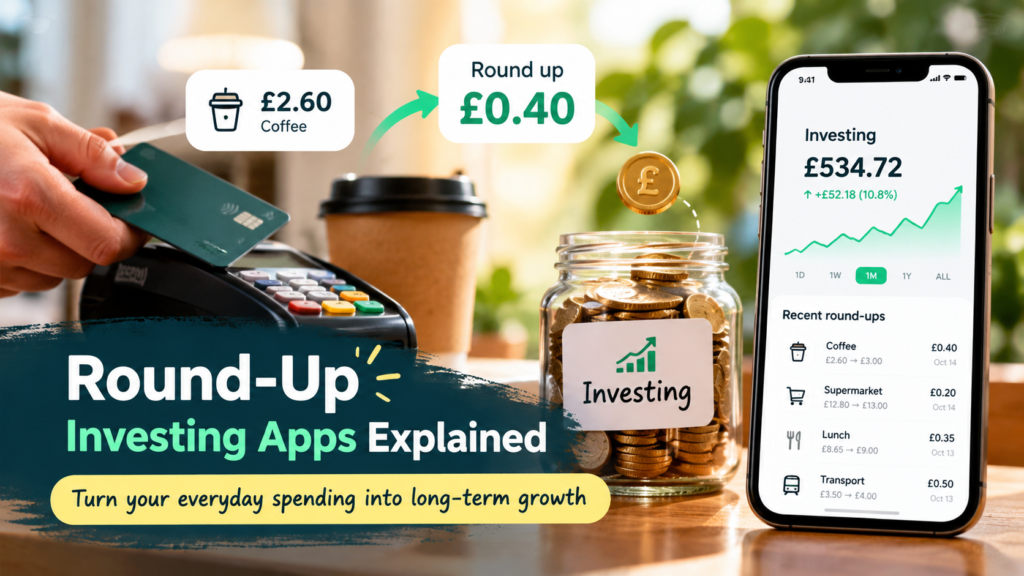

If you have ever wondered whether the spare change from everyday purchases can be put to work, round-up investing apps offer a simple way to do it. The basic idea is straightforward: a purchase is rounded up to the next whole pound, and the difference can be collected and invested according to the service’s rules.
That sounds small, but the appeal is not that a few pence suddenly become a fortune. The real attraction is automation. Instead of having to remember to move money into an investment account, small amounts can be collected in the background as you spend.
This guide explains how round-up investing works, what happens to the money, the main costs and risks to check, and when this approach may or may not make sense for a beginner.
What Is Round-Up Investing?
Round-up investing is a form of micro-investing that turns the difference between a purchase price and the next whole unit of currency into an investment contribution.
For example, imagine you buy a coffee for £3.40. A round-up feature could treat the transaction as £4.00 and set aside the remaining £0.60. If you make several purchases during the week, those small differences can accumulate.
The exact mechanism varies between providers. Some services collect the round-ups and transfer them after they reach a threshold, while others may use a different collection or investment schedule. The important point is that the investment contribution comes from small amounts linked to ordinary spending.
How Do Round-Up Investing Apps Work?
Although individual services differ, the process usually follows a few basic stages.
1. You connect an eligible payment account
A round-up service needs a way to identify eligible transactions. Depending on the provider, this may involve linking a bank account, payment account or card.
Before connecting anything, check who operates the service, what permissions you are granting, and whether the relevant financial firm is authorised or registered where required. The Financial Conduct Authority advises consumers to check the status of firms providing certain account information or payment services. FCA guidance can help explain what to look for.
2. Your purchases are rounded up
Suppose you make these purchases:
- £2.70 → £0.30 round-up
- £5.25 → £0.75 round-up
- £8.60 → £0.40 round-up
The potential round-up total from those three transactions would be £1.45.
These amounts are small by design. The idea is to make investing feel more like a background habit than a separate monthly task.
3. The round-ups are collected
The service may collect the accumulated amount periodically rather than investing every few pence immediately. There can be a minimum threshold or a particular transfer schedule.
This is one reason you should read the provider’s current terms rather than assuming every round-up app works in exactly the same way.
4. The money is invested
Once the money is ready to invest, the provider applies the investment instructions associated with your account. That could mean buying units or fractional interests in an investment portfolio, fund or other eligible investment, depending on the service.
The key distinction is important: a round-up is only a method of funding an investment. It does not remove investment risk.
Does Round-Up Investing Really Save Money?
Round-up investing can help you build an investing habit, but it should not be confused with guaranteed saving or guaranteed growth.
If you spend more, you may generate more round-ups. If you spend less, you may generate fewer. And once the money is invested, its value can rise or fall.
The strongest benefit for many beginners is therefore behavioural: the system can make small, regular contributions easier to maintain. The long-term result depends on how much is contributed, how long it stays invested, the investments chosen, fees and charges, and investment performance.
Round-Up Investing vs Manually Investing Small Amounts
You do not need a round-up feature to invest small amounts. You could simply transfer a fixed amount yourself each week or month.
| Approach | Main advantage | Potential drawback |
|---|---|---|
| Round-up investing | Automates very small contributions | Contribution size can vary with spending |
| Fixed regular investing | Creates a predictable contribution plan | Requires you to set and maintain the contribution |
| Occasional manual investing | Maximum control over timing and amount | Easy to postpone or forget |
For a beginner, the right choice is less about finding a clever trick and more about choosing a method you can understand, afford and maintain.
What Are the Benefits of Round-Up Investing?
It can make investing feel more manageable
Large one-off contributions can feel intimidating. Small contributions may feel easier to start with, particularly for someone who is still learning how investing works.
It can automate a habit
Automation reduces the number of decisions you need to make every time you want to contribute. That can make consistency easier.
It can introduce beginners to investing
Starting with small amounts can give a new investor an opportunity to learn about balances, portfolios, fees, risk and market movements without making the initial contribution the main focus.
It can complement a wider money plan
Round-ups can sit alongside budgeting, emergency savings and a regular investment plan. They do not have to be the only way you invest.
What Are the Risks and Drawbacks?
Small contributions are still investments
The value of investments can fall as well as rise. A round-up feature does not protect you from market losses.
Fees can matter
Fees that look small in pounds can have a meaningful effect when your investment balance is small. Check subscription charges, platform fees, fund or portfolio costs, transaction charges and any other applicable costs.
The FCA has highlighted the importance of consumers being able to identify and compare investment charges clearly. Its reviews have found that some costs can be harder to locate than others. FCA review of investment platform costs.
Spending more is not a wealth strategy
A common psychological trap is thinking that more spending automatically means more investing because it creates more round-ups. It does not. Spending £100 simply to create a few pounds of round-ups is not a sensible investing strategy.
You may invest without thinking about the underlying portfolio
Automation is convenient, but you should still understand what your money is invested in, the level of risk involved and whether the investment matches your goals and time horizon.
What Should You Check Before Using a Round-Up App?
Before signing up, work through this checklist:
- Regulation and provider status: check the provider and understand which regulated firm is actually providing the financial service.
- Total costs: look beyond a headline “free” or “low-cost” claim and find the complete list of applicable charges.
- Where the money is invested: understand the fund, portfolio or other investment used.
- Risk level: make sure you understand that investment values can go down as well as up.
- Round-up rules: check which transactions qualify, when money is collected and whether thresholds apply.
- Withdrawal rules: understand how and when you can access your money.
- Account protection: understand what protections may apply to the relevant cash or investment service rather than assuming every balance has the same protection.
- Data permissions: understand what financial information the app can access and why.
The FCA has also warned that some trading-app design features can encourage more frequent or riskier trading. A simple, automated investing feature should not be treated as a reason to trade more often or take more risk. FCA guidance on trading-app design and its research on digital engagement practices.
Who Could Benefit From Round-Up Investing?
Round-up investing may suit someone who:
- wants to start investing with very small amounts;
- values automation;
- is willing to learn what their money is invested in;
- has basic spending and emergency-savings needs under control; and
- understands that investment returns are not guaranteed.
It may be less suitable if you are relying on every pound for essential expenses, have expensive high-interest debt that needs attention first, or are using the feature without understanding the investment risk and charges.
How Round-Up Investing Fits Into a Bigger Plan
Round-ups work best when they are treated as one small part of a wider financial plan. Your priorities might include building an emergency fund, paying down costly debt, making regular investments and keeping an appropriate cash reserve.
If you are completely new to micro-investing, our guide to how micro-investing works explains the wider concept. You can also read about micro-investing fees and micro-investing risks before choosing a service.
Final Thoughts
Round-up investing apps turn spare change from everyday purchases into small investment contributions. Their biggest strength is simplicity: they can make investing more automatic and reduce the friction of getting started.
But automation is not the same as safety, and small contributions are not guaranteed to grow. The sensible approach is to understand the provider, check the full costs, know what you are investing in and make sure round-ups fit within a broader money plan.
For beginners, the goal should not be to find an app that makes investing feel effortless at any cost. The goal is to build a sustainable habit while understanding where your money is going and what risks you are taking.
Educational content only. This article is not personal financial advice. Investment values can fall as well as rise, and you may get back less than you invest.