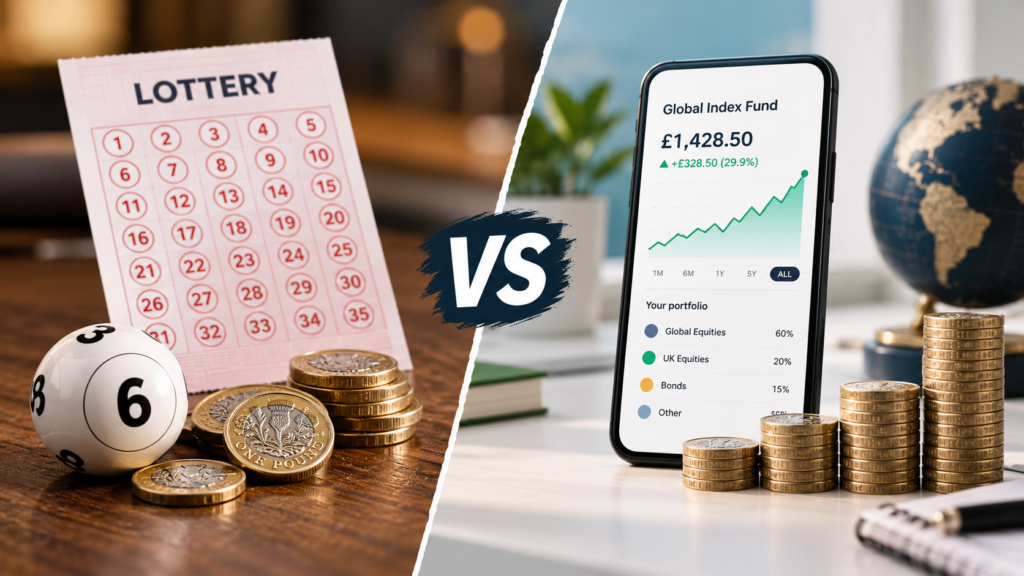

Putting a few pounds towards a lottery ticket and investing a few pounds each week can both feel like small steps towards a better financial future. But they work in fundamentally different ways. A lottery ticket buys a chance to win a prize; an investment buys exposure to an asset that may rise or fall in value over time.
For UK beginners, the useful question is not which one promises a bigger headline number. It is what each option is designed to do, what could happen to the money you put in, and whether the choice fits your financial priorities.
Key point: lottery play is gambling, not investing. Investing also involves risk, and you can lose money. Neither option guarantees a profit.
What Is the Difference Between Micro-Investing and the Lottery?
Micro-investing means investing relatively small amounts, often through regular contributions or an app. Your money is used to buy an investment, such as units in a fund or shares, depending on the platform and your choices. The investment has an underlying value, although its market price can change.
Lottery tickets give you a chance to win a prize based on a random draw or game outcome. Buying more tickets may change your chances under that game’s rules, but it also costs more and does not turn the ticket into an asset that can generate investment returns.
They are therefore not interchangeable ways to build wealth. Investing involves owning assets and accepting market risk. Lottery play involves paying for a chance-based outcome where most players do not win a major prize.
Micro-Investing vs Lottery Tickets at a Glance
| Question | Micro-investing | Lottery tickets |
|---|---|---|
| What do you buy? | Exposure to an investment, such as a fund or share | A chance to win a prize under the game’s rules |
| What drives the outcome? | Market prices, income, fees, contributions and time | Random draw or game result and published prize rules |
| Can you lose the money spent? | Yes; investment value can fall, possibly sharply | Yes; a ticket may return no prize |
| Can returns be forecast? | No; future investment returns are uncertain | No; the result of a particular draw cannot be predicted reliably |
| Is it a plan for long-term goals? | It may form part of a long-term plan if suitable | No; it should not be relied on to fund financial goals |
| Do costs matter? | Yes; platform, fund, dealing and other fees reduce results | Yes; ticket spending adds up, even when there is no prize |
What Are the Odds of Winning the Lottery?
Lottery odds vary by game and prize tier, so always check the official rules for the exact ticket you are considering. For example, The National Lottery’s published Lotto information gives the chance of matching all six main numbers for the jackpot as 1 in 45,057,474. The odds of winning any prize are much shorter because that includes lower prize tiers, such as a free Lucky Dip; winning any prize is not the same as making a profit.
That distinction matters. A ticket might win a small prize without recovering the money spent on multiple tickets. A jackpot is possible, but it is not a realistic financial plan. Review the current game details directly at The National Lottery’s official Lotto page, because game rules and prize structures can change.
How Does Micro-Investing Work Instead?
With micro-investing, a small contribution is used to buy an investment offered by your provider. You might contribute a fixed amount each week or month, or use a round-up feature. What you own depends on the investment selected and the provider’s terms.
For example, you could set aside £5 a week for a diversified investment fund. The fund may hold many companies or other assets rather than relying on one outcome. Diversification can reduce dependence on a single holding, but it cannot eliminate investment losses. Read the FCA’s explanation of diversification before assuming that a fund is automatically low risk.
Micro-investing is not a guaranteed way to grow money. Share prices and fund values fluctuate, costs reduce returns, and you may get back less than you invest. The FCA explains the relationship between risk and uncertain returns in its guide to investment risk and returns.
A Simple £5-a-Week Example
Imagine you have £5 a week available after essential bills, debt repayments and cash savings are taken care of. Over one year, that is £260; over five years, it is £1,300 in total contributions or spending, before considering any investment returns, charges or prizes.
| Over five years | What the £5 a week represents |
|---|---|
| Lottery spending | £1,300 spent on tickets. The amount returned depends on wins; it could be less than the spend or, rarely, much more. |
| Investment contributions | £1,300 paid into investments. The final value could be above or below that amount after market movements and fees. |
This is an illustration of cash flow, not a forecast or a like-for-like prediction. The lottery result is based on chance; the investment result depends on the assets, market performance, time invested and costs. An investment may lose money, including over a long period.
Which Is Better for Building Long-Term Wealth?
If the goal is to build wealth over time, a properly researched investment plan is designed for that purpose in a way that lottery tickets are not. The aim is to contribute money you can afford to leave invested, choose assets that fit your goals and risk tolerance, understand costs, and review the plan over time.
That still does not mean every investment is sensible. Buying one speculative share or a high-risk product because it seems exciting can expose you to substantial losses. A diversified portfolio, a suitable timeframe and a clear understanding of the investment matter far more than how small the first contribution is.
Lottery play should be treated as entertainment with a fixed cost you can afford to lose—not as a savings strategy, emergency fund or retirement plan. Do not increase spending to chase a previous loss or because a win feels overdue.
Before You Invest, Check Your Financial Foundations
Small contributions still come after everyday financial priorities. The FCA’s golden rules of investing advise people to get day-to-day finances in order, keep accessible emergency savings, deal with expensive debt and understand both the risks and charges before investing.
- Protect essential spending: rent or mortgage, food, bills and debt repayments come first.
- Build accessible savings: money needed for emergencies or near-term expenses generally should not depend on a volatile investment.
- Understand what you are buying: check the underlying assets, risks, fees and how you can access your money.
- Verify the provider: use the FCA Register or Firm Checker to check the firm and the permissions relevant to the service.
- Keep the amount sustainable: choose an affordable contribution, and remember that investing is optional if your finances are not ready.
Our guides to building an emergency fund before investing, micro-investing fees and micro-investing risks cover these steps in more detail.
Common Mistakes to Avoid
Thinking a lottery ticket is an investment
A ticket does not give you ownership of an asset or a reliable route to compounding. Treat it as entertainment, not as a strategy for funding a future goal.
Assuming investments always rise
Market investments can fall in value. Past performance and hypothetical examples do not guarantee future results, and a small initial contribution does not make an investment safe.
Ignoring fees on a small portfolio
A fixed monthly platform charge can consume a material share of a small balance. Check all applicable platform, fund, transaction and currency costs before starting.
Using money you cannot afford to lose
Do not borrow to invest or use bill money to buy lottery tickets. If you cannot comfortably afford either choice, keeping the money for essential needs or accessible savings is the more appropriate priority.
Chasing losses or a big win
There is no reliable system that predicts lottery numbers. If gambling starts affecting your finances or feels difficult to control, GamCare offers free, confidential support on 0808 8020 133, 24 hours a day, seven days a week: GamCare.
Frequently Asked Questions
Is micro-investing safer than playing the lottery?
They involve different kinds of risk. Lottery tickets can lose their full cost if they do not win a prize. Investments can also lose value, and you may get back less than you contribute. A suitable diversified investment is intended for a financial goal, but it is not risk-free.
Can I invest £5 a week?
Some providers allow small regular contributions, but minimums and fees vary. Check the provider’s current terms and make sure the amount fits your budget. You do not need to invest if essential expenses, expensive debt or emergency savings need attention first.
Could lottery winnings make me wealthy faster?
A major win could produce a large one-off amount, but the odds are very low and there is no dependable way to predict the outcome. It should not be used as the basis of a financial plan.
Does investing small amounts guarantee compound growth?
No. Compounding can occur when positive returns remain invested, but investment returns vary and losses can happen. Learn more in our guide to compound growth for small investments.
Should I stop buying lottery tickets and start investing?
That is a personal decision and this article is not individual financial advice. A useful first step is to review your budget and goals, understand the difference between gambling and investing, and consider whether any money is genuinely available for long-term risk.
The Bottom Line
Micro-investing and lottery tickets both let someone spend small amounts, but the similarity ends there. A lottery ticket purchases a chance-based result; investing creates exposure to assets whose value may fluctuate. If you want to work towards a long-term financial goal, focus on affordable saving, understanding investment risk, diversification and costs—not on a jackpot.
This article is for general financial education and is not personal financial, investment, tax or gambling advice. Investments can fall as well as rise and you may get back less than you invest. Lottery play carries a risk of losing the money spent.