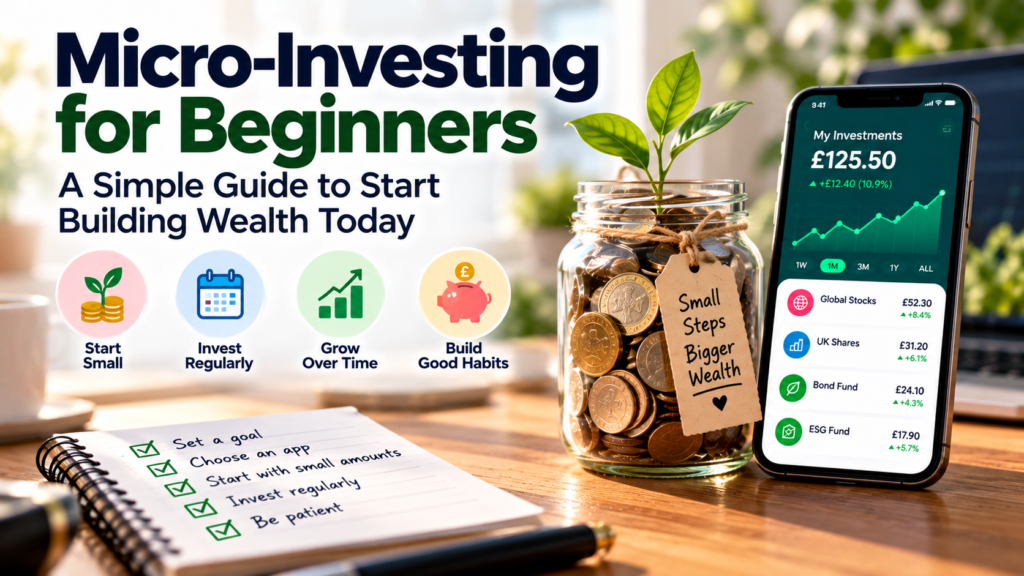

Starting to invest can feel complicated when you are looking at share prices, funds, fees, market movements and unfamiliar financial terms. Micro-investing can make the entry point smaller, but it does not change the basic rules of investing. You are still putting money into assets that can rise and fall in value.
For beginners, the most useful way to think about micro-investing is not “How little can I invest?” but “How can I start with an amount I can afford, understand what I own, and build a sensible long-term habit?”
What Is Micro-Investing?
Micro-investing generally means investing relatively small amounts of money, often through digital investment platforms that make recurring contributions, fractional shares or automated portfolios easier to use.
If you are completely new to the subject, start with our guide What Is Micro-Investing?. It explains the basic concept before you move into the practical steps covered here.
Is Micro-Investing Suitable for Every Beginner?
Not necessarily. Investing should fit around your wider financial position. The FCA’s current InvestSmart guidance says people should have their day-to-day finances in order before investing, including having accessible emergency savings and dealing with expensive debt. It also stresses that investments can fall in value.
This means the first question is not which investment app to download. It is whether the money you are considering investing is money you can leave exposed to investment risk.
FCA InvestSmart: The golden rules of investing
Step 1: Decide Why You Are Investing
A clear goal gives your investing plan a purpose. Your goal could be learning how investing works, building a long-term portfolio, saving for a future purchase, or gradually increasing your invested assets.
The time you expect to leave the money invested matters too. Money needed in the near term may be better suited to savings or other lower-volatility options rather than assets whose market value can change significantly.
Step 2: Start With an Amount You Can Afford
There is no universal “correct” micro-investing amount. £5, £10, £25 or £50 can all be examples of small contributions, but none should be treated as a recommendation for everyone.
Build the contribution around your real budget. A smaller amount that you can maintain without disrupting essential spending is more practical than choosing a larger amount that you repeatedly need to stop.
Our guide How Much Money Do You Need to Start Investing? explores the relationship between starting capital, contribution size and investing goals in more detail.
Step 3: Learn What You Are Actually Buying
Before putting money into an investment, understand the asset behind the app or account. Depending on the service, you may be buying individual shares, ETFs, funds or a managed portfolio.
A small amount invested in one company is still concentrated in that company. A small amount invested in a diversified fund can give exposure to many holdings. The amount you invest and the risk of the investment are two different questions.
Investor.gov explains that diversification means spreading money among investments rather than relying on one holding. Diversification cannot eliminate losses, but it can reduce reliance on any single investment.
Investor.gov: Diversify Your Investments
Step 4: Understand Fractional Shares
Fractional shares allow some platforms to let customers own less than one whole share of an eligible security. This can make it possible to invest smaller amounts when a complete share would otherwise cost more than the intended contribution.
However, fractional ownership is not identical across providers. Availability, order execution, dividends, voting rights, transfers and other features can vary. Read the provider’s current terms before relying on a particular fractional-share feature.
Step 5: Choose a Simple Investment Approach
Beginners often encounter a long list of possible investments. You do not need to understand every financial product before learning the fundamentals, but you should understand the investment you actually choose.
A diversified fund or ETF may hold many underlying assets, while an individual share represents exposure to one company. Neither label automatically makes an investment suitable for every person. The relevant questions are what it owns, how diversified it is, what it costs, how liquid it is and how much price fluctuation you can tolerate.
Step 6: Consider Regular Contributions
Many micro-investing services allow recurring contributions. Regular investing can help turn investing into a routine rather than a decision you have to make from scratch every week or month.
Regular contributions also mean that you buy at different market prices over time. That does not guarantee a profit and does not remove market risk. It simply describes how repeated purchases work.
Step 7: Understand Fees Before You Start
Fees matter particularly when your account balance is small. A platform charge that looks insignificant in isolation can represent a meaningful percentage of a small portfolio.
Depending on the provider and product, costs can include platform fees, fund expenses, trading charges, foreign-exchange costs, subscription charges and other account costs. Do not assume that “commission-free” means the service has no costs.
Investor.gov notes that even seemingly small investment fees can have a significant effect on portfolio value over time because fees reduce the amount of money available to earn returns.
Investor.gov: Understanding Fees
Step 8: Check That the Provider Is Authorised
If you are in the UK, check the Financial Conduct Authority’s Financial Services Register when assessing whether a firm is authorised. Authorisation does not mean an investment will make money, and you should still understand what product and service you are buying.
Be especially cautious about unsolicited investment opportunities, unrealistic return promises and pressure to transfer money quickly.
Step 9: Build a Basic Beginner Checklist
- Budget: Can I invest this money without affecting essential expenses?
- Goal: Why am I investing and when might I need the money?
- Investment: What exactly will I own?
- Diversification: Am I relying too heavily on one company, sector or market?
- Fees: What will I pay to buy, hold, sell or transfer the investment?
- Risk: What would I do if the investment fell substantially?
- Provider: Is the platform legitimate and appropriately authorised for the service it provides?
A Practical £25 Example
Suppose a beginner decides that £25 a month fits comfortably within their budget. They select an investment available through their platform and arrange a recurring monthly contribution.
- Month 1: contribute £25.
- Month 2: contribute another £25.
- Month 3: contribute another £25.
- Continue only while the contribution remains affordable and consistent with the investment plan.
After three contributions, £75 has been contributed before fees and investment performance. The account value could be higher or lower than the amount contributed. This example illustrates the contribution process, not a promised return.
What Beginners Should Avoid
- Investing money needed for bills or emergencies.
- Using borrowed money or credit to invest.
- Choosing an investment because its price recently went up.
- Putting everything into one popular stock or theme.
- Ignoring fees because the starting amount is small.
- Checking the portfolio constantly and reacting to every short-term movement.
- Believing claims of guaranteed or unusually high returns with little risk.
Micro-Investing Is a Method, Not a Guaranteed Outcome
One of the most important beginner lessons is that micro-investing describes how you invest, not how much you will earn. Small contributions can still lose value, and a larger contribution does not automatically produce better results either.
What matters is the combination of contribution level, investment selection, diversification, costs, time horizon and market performance. Investor.gov notes that all investments involve risk, while the FCA emphasises the relationship between risk and potential returns.
How This Fits Into the TinyWealth Micro-Investing Series
If you are following this topic step by step, read What Is Micro-Investing? first, then see How Does Micro-Investing Work? for the mechanics behind accounts, contributions, fractional shares, automation, fees and withdrawals.
You can also compare the approach with broader investing through our guide to Micro-Investing vs. Traditional Investing.
Frequently Asked Questions
How much money does a beginner need to start micro-investing?
There is no single amount that applies to everyone. The practical starting amount depends on the provider’s minimums and your own budget. A contribution should be affordable after essential expenses and other financial priorities are covered.
Is micro-investing low risk?
Not automatically. Investing a smaller amount means less money is exposed in absolute terms, but the underlying investment can still fall in value. Risk depends on what you own and how the portfolio is constructed.
Should beginners invest in individual stocks?
Individual stocks can provide direct exposure to a company, but they can also create concentration risk. Beginners should understand the difference between owning one company and owning a diversified portfolio before making that choice.
Can small investments grow through compounding?
Investment returns can compound when returns remain invested and generate further returns. The effect depends on the actual investment performance and the period invested; it is not a guarantee of growth.
Final Thoughts
For a beginner, micro-investing can be a practical way to learn how investing works without starting with a large contribution. The important part is the process around the investment: know your goal, invest only money you can afford to expose to risk, understand the asset, check the costs, diversify where appropriate and use a legitimate provider.
Starting small can be useful. Starting without understanding what you are buying is a different matter.
Educational note: This article is for general informational purposes and is not personalised financial, investment, tax or legal advice. Investments can fall as well as rise, and you may lose money.