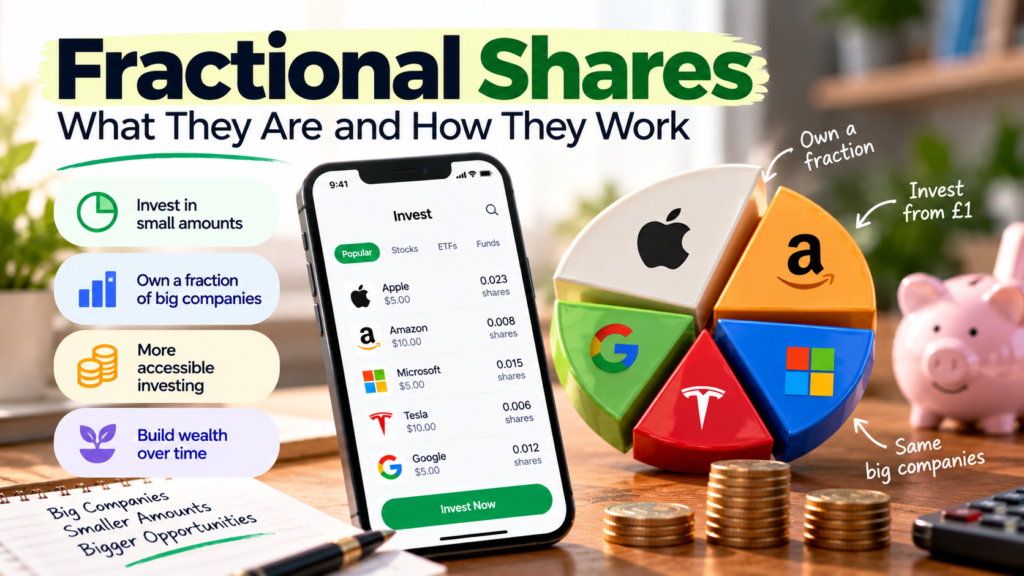

Fractional shares let an investor own less than one whole share of an eligible investment. Instead of needing enough money to buy a complete share, a platform may allow you to invest a smaller cash amount and receive a corresponding fraction.
This feature is one reason micro-investing can work with relatively small contributions. But fractional ownership does not make an investment safer, and the rules can differ significantly between providers. Before using fractional shares, it helps to understand exactly what you own, how trades are executed, what fees apply and what happens if you later want to sell or transfer the holding.
What Is a Fractional Share?
A fractional share is less than one full share of a stock or other security. For example, if a share costs £500 and a platform allows fractional investing, an investor could potentially put £50 into that share and receive an economic interest equivalent to 0.1 of a whole share, subject to the provider’s rules and the actual execution price.
The important point is that the fraction is created through the investment service’s structure. You should not assume that every platform provides the same ownership rights or trading experience as holding a whole share directly.
The SEC’s Investor.gov explains that fractional-share availability, eligible securities, order execution, order types, dividends, voting rights, fees and liquidity can vary by brokerage. Investor.gov: Fractional Share Investing
Why Do Fractional Shares Matter for Micro-Investing?
Whole-share prices can create a practical barrier for someone starting with a small amount. Fractional investing can lower that barrier because the investor may be able to specify a cash amount rather than purchase one complete share.
- A high-priced share can become accessible with a smaller contribution.
- Regular contributions can be invested without waiting until enough cash has accumulated for a whole share.
- A portfolio can potentially hold small positions in several eligible investments.
- Automatic or recurring investing can be easier when the platform supports dollar- or pound-based orders.
These are access and convenience benefits. They do not change the underlying market risk of the investment.
How Does Fractional Share Investing Work?
1. Choose an eligible investment
First, the investor selects a security that the provider makes available for fractional investing. A platform may support fractional shares for some stocks but not others, and some providers may also support selected ETFs.
2. Enter a cash amount or fraction
Depending on the platform, you may be able to enter an amount of money or a number of fractional shares. For example, an investor might enter £25 rather than specifying one whole share.
3. The platform executes the order
Execution methods differ. Some providers may execute fractional orders in real time, while others may aggregate customer orders and execute them together. The timing and method can affect the price received.
4. Your account records the fractional holding
The account will show the amount of the security attributed to you. The exact legal and custody structure depends on the provider, so read the account terms rather than assuming that a fractional holding gives identical rights to a whole share.
A Simple Example
Imagine a company share is trading at £400 and a platform supports fractional investing. An investor contributes £40.
| Item | Example |
|---|---|
| Share price | £400 |
| Amount invested | £40 |
| Illustrative fraction | 0.10 share |
This is a simplified illustration. The actual number of fractional shares received depends on the execution price, applicable charges and the provider’s rules. If the share price later falls to £360, a 0.10-share holding would be worth about £36 before any applicable costs. If it rises to £440, the same holding would be worth about £44.
The example demonstrates the relationship between the whole-share price and the fractional holding; it does not predict future returns.
Do Fractional Shares Pay Dividends?
They can, but the way dividends are handled depends on the provider and the structure of the fractional investment. If a company pays a dividend, a fractional holder may receive a proportionate amount based on the fraction owned, subject to the provider’s terms.
For example, if a whole share receives a £2 dividend and an investor has an economic interest equivalent to 0.25 of a share, a simple proportional calculation would be £0.50 before any applicable deductions. The actual treatment should always be checked with the provider.
Do Fractional Shares Have Voting Rights?
Not necessarily. Voting rights can depend on how the provider structures fractional ownership. Investor.gov notes that some brokerage firms provide voting rights for fractional holdings while others do not. Investor.gov: Fractional Share Investing
This is one reason not to assume that owning 0.2 of a share gives you exactly the same shareholder rights as owning a whole share directly.
Can You Transfer Fractional Shares?
Transferability is another important difference between providers. Some fractional holdings may not be transferable to another brokerage. In some situations, a provider may require fractional positions to be sold before an account can be transferred.
The FCA has highlighted transferability, trading arrangements, fees, execution practices and ownership rights as areas firms offering fractional shares should explain clearly to retail customers. FCA: Expectations for firms offering fractional shares
What Are the Risks of Fractional Shares?
Fractional shares have many of the same investment risks as the underlying security. If the underlying share falls in value, the fractional holding can fall in value too.
- Market risk: the underlying investment can lose value.
- Concentration risk: owning small amounts of several individual companies does not necessarily create a diversified portfolio.
- Execution risk: the provider’s order-handling process can affect the price and timing of a trade.
- Liquidity considerations: fractional positions may have different selling arrangements from whole shares.
- Transfer limitations: a fractional holding may not be transferable to another provider.
- Fee impact: transaction, platform or currency costs can matter more when contributions are small.
- Rights and structure: voting, dividend and ownership arrangements can vary by provider.
Fractional investing therefore solves an access problem; it does not remove investment risk.
Fractional Shares vs Whole Shares
| Feature | Whole share | Fractional share |
|---|---|---|
| Ownership amount | One complete share | Less than one share |
| Starting amount | May need enough for one full share | Can potentially start with a smaller cash amount |
| Availability | Usually broader | Depends on provider and security |
| Voting rights | Generally tied to the share structure | May be limited or handled by the provider |
| Transferability | Usually easier to transfer | May be restricted |
| Execution | Standard order arrangements | May involve special fractional-order processes |
Fractional Shares Do Not Automatically Mean Diversification
This distinction is especially important for beginners. Buying £20 of one expensive company through fractional shares is still exposure to one company. The fact that the investment is small does not make it diversified.
A diversified fund or ETF can provide exposure to many underlying holdings, depending on its strategy. For a beginner, understanding diversification is therefore just as important as understanding fractional ownership.
See our guide Micro-Investing for Beginners for a broader checklist covering goals, affordability, diversification, fees and risk.
What Should You Check Before Buying Fractional Shares?
- Which stocks, ETFs or other securities are eligible?
- Can you invest by cash amount, share fraction or both?
- How are fractional orders executed?
- Are there minimum order amounts?
- What fees and currency-conversion charges apply?
- How are dividends handled?
- Do fractional holdings have voting rights?
- Can fractional holdings be transferred to another provider?
- How are fractional holdings treated when you close the account?
- What happens if the provider becomes unable to operate?
For UK investors, the FCA’s guidance on fractional shares specifically highlights transferability, trade execution, fees, voting rights, dividends and ownership rights as areas that firms should explain to consumers. FCA: Expectations for firms offering fractional shares
How Fractional Shares Fit Into Micro-Investing
Fractional shares are one tool that can make small contributions practical. They can work particularly well with recurring investing because the investor can contribute a fixed cash amount without waiting for that amount to equal the price of a whole share.
But the bigger investing decisions remain the same: decide what the money is for, understand the investment, consider diversification, understand fees and make sure the amount invested is affordable for your circumstances.
For the mechanics of recurring contributions and micro-investing, read How Does Micro-Investing Work?. For the broader beginner framework, see What Is Micro-Investing?.
Frequently Asked Questions
Are fractional shares real shares?
A fractional share represents less than one whole share, but the legal and custody structure can vary by provider. Check the platform’s terms to understand what rights and ownership interest your fractional holding represents.
Can beginners buy fractional shares?
Some investment platforms make fractional investing available to retail customers. Availability depends on the provider, the security and the account type. Always check the current terms before investing.
Are fractional shares less risky than whole shares?
No. A smaller position means less money is exposed in absolute terms, but the underlying investment can still rise or fall. Fractional ownership does not change the market risk of the underlying asset.
Can I build a diversified portfolio using fractional shares?
Potentially. Fractional investing can make it easier to allocate small amounts across multiple eligible investments, but diversification depends on what you actually own. A collection of individual stocks can still be concentrated by company, sector or market.
Final Thoughts
Fractional shares can make investing more accessible when a whole share costs more than you want to contribute. They can also make recurring small contributions easier to implement.
The key is to look beyond the fraction itself. Check the underlying investment, diversification, fees, execution process, dividend treatment, voting rights, transferability and the provider’s terms before you invest.
Fractional shares can reduce the amount of money needed to access an investment. They do not reduce the investment risk of that asset.
Educational note: This article is for general informational purposes and is not personalised financial, investment, tax or legal advice. Investments can fall as well as rise, and you may lose money.